
AI is taking work out of the MSP’s service desk, which raises the question of what the client is still paying for with a monthly per-seat fee. The figures show a more modest gain than the stories suggest: according to Kaseya, 55 per cent of MSPs have automated no more than a quarter of their work, and Australian MSP GCIT, which published seven months of service desk data from its use of AI, sees tickets resolved 24 to 34 per cent faster with roughly 15 per cent fewer hours. Halving the workload is nowhere in sight: in a sample of 240 tickets, only 49 per cent could be handled without someone at the device or someone at another vendor. The pressure on pricing is real, though: ISG sees AI productivity having a visible deflationary effect on service providers’ rates, software vendors such as HubSpot and Intercom are moving to payment per resolved query, and 37 per cent of MSPs cite clients who find the price too high as the biggest obstacle to satisfaction. This article calculates what AI does to the cost of a ticket, shows that the per-seat price was never an hourly rate, and describes four ways to link the price to risk and outcomes instead of hours, with a worked example for an MSP managing 1,000 seats.
In this article: How much work does AI really remove? | Where will the client dispute the bill? | What does the per-seat price actually sell? | Four ways to decouple the price from hours | Worked example for an MSP with 1,000 seats | What to tell the client at the next renewal
Clients read that AI is taking over half of all IT work and ask at renewal why the per-seat price stays the same (or goes up). MSPs see their own technicians working faster and wonder whether they can keep that gain in their margin or should pass it on before a competitor does. Both questions rest on the same assumption: that the per-seat price is a disguised quantity of hours. As long as that assumption holds, the party that comes in first with a lower rate wins. The way to stay out of that race is to peg the price to something other than the hours behind it.
How much work does AI really remove?
The honest picture is that AI speeds up work in the service desk but certainly does not yet halve it. In Kaseya’s 2026 State of the MSP Report, 55 per cent say they have automated no more than a quarter of their work over the past two years, 28 per cent put the figure at around half and 1 per cent describe themselves as almost fully automated. The KPIs that improved most are first response time (35 per cent of MSPs), client satisfaction (33 per cent) and technician efficiency (32 per cent). Profit margin (18 per cent) and billing (15 per cent) are at the bottom of the list. Automation therefore shows up first in speed and only much later in the figures.
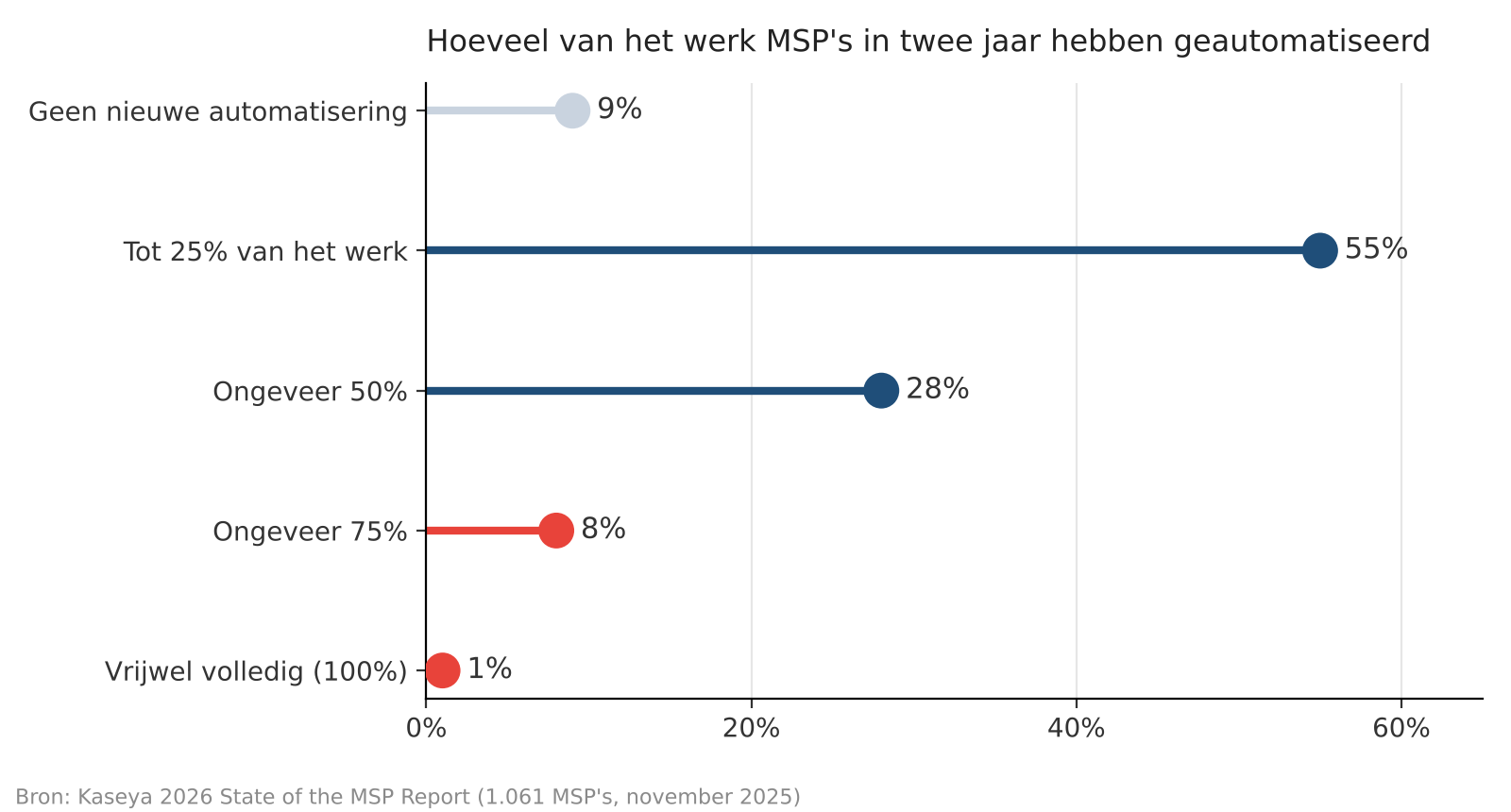
Figure 1. More than half of MSPs have automated no more than a quarter of their work. Source: Kaseya 2026 State of the MSP Report.
It gets more concrete at GCIT, an MSP from Queensland, Australia, with five to seven technicians and around 1,500 billed users, which published seven months of service desk data in October 2026. Since March 2026 it has been running an AI triage layer that takes 98.7 per cent of new tickets off the triage board, and technicians use an AI assistant on 82 per cent of the tickets they pick up. The wait before a technician starts on a ticket fell from 49 to 13 working minutes, the median resolution time from 2.42 to 1.84 working hours and technician hours spent on tickets per month from 449 to 381, roughly 15 per cent fewer. The number of tickets resolved per technician per month rose by 47 per cent, partly because ticket volume itself grew by almost 10 per cent. Over the same period, the company’s EBITDA went from 6.6 to 14.7 per cent of revenue.
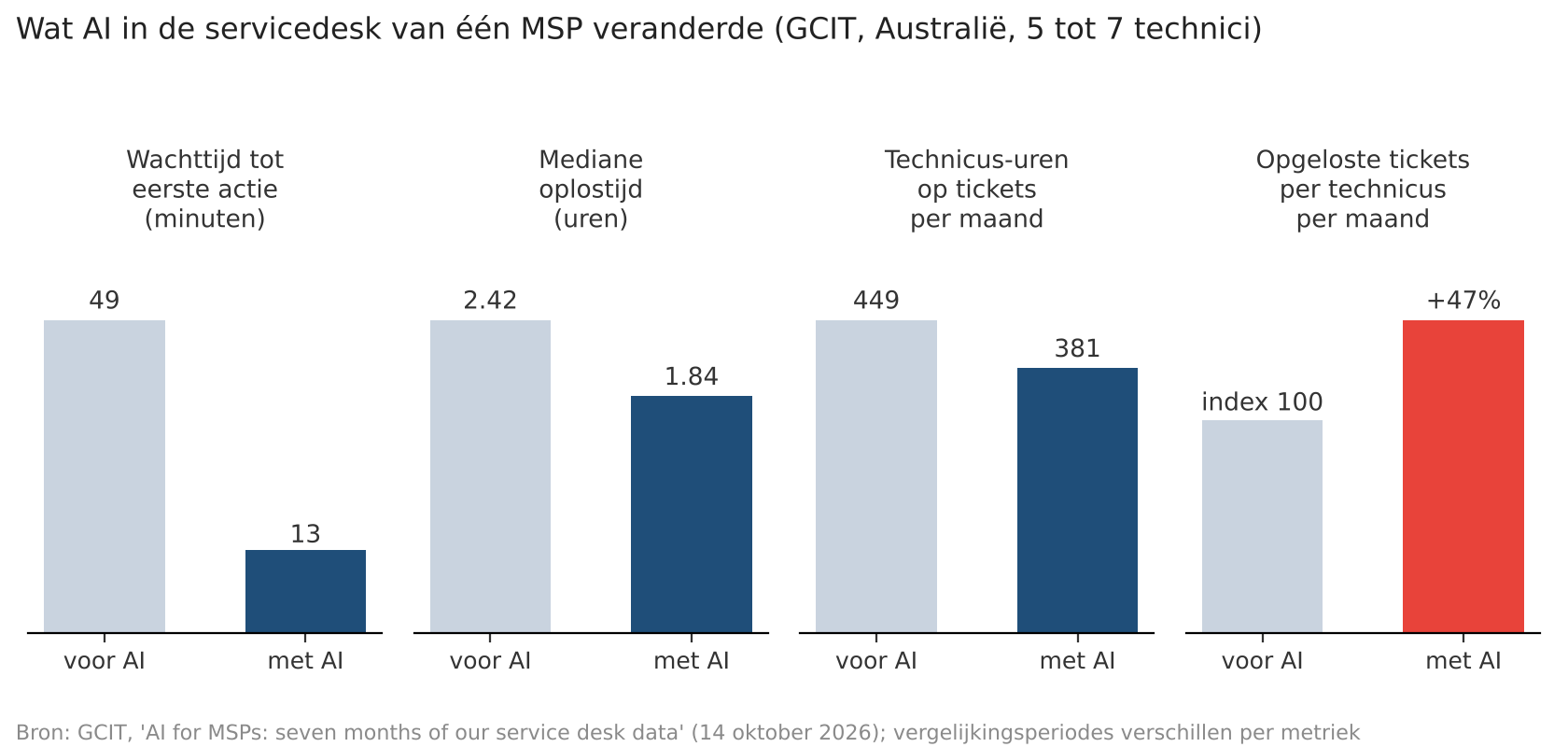
Figure 2. AI speeds up GCIT’s service desk considerably, but saves around 15 per cent of technician hours. Source: GCIT, October 2026.
In a sample of 240 tickets, 15 per cent needed someone at the device, 6 per cent physical work and 5 per cent another vendor. Only 49 per cent could be handled entirely with nothing more than the client’s permission. Of the 3,955 resolution plans the AI drew up, 19 per cent were rejected by its own checks, and a second triage product assigned the wrong type to 52 per cent of tickets. So there are gains to be had, but halving the work remains largely fiction for now. That is important to know before you sit across from a client who walks in with that fiction.
Where will the client dispute the bill?
That the client will walk in with it is beyond doubt. ScalePad asked more than 1,100 North American MSPs what is stopping them from achieving higher satisfaction scores, and 37 per cent put ‘clients find the price too high’ at the top, level with increasingly complex technical requests. In JumpCloud’s survey of SMEs, cost was the most frequently cited reason for leaving an MSP, at 28 per cent. Kaseya, meanwhile, sees contracts shrinking: the share of clients spending more than $25,000 a year fell from 75 to 41 per cent, 24 per cent of MSPs report clients cutting their IT budget and 30 per cent cite rising wage, tooling and infrastructure costs as a brake on growth. A market in which costs are rising and contract value is falling leaves little room for a price built on hours.
The second source of pressure sits higher up the chain. In October 2026, sourcing advisory firm ISG observed that AI productivity is starting to have a visible effect on prices in the managed services market and that service providers using AI in their delivery are having a significant deflationary effect on rates. The European managed services market grew by 12 per cent in the third quarter to $4.3 billion, but annual contract value was 10 per cent lower than the previous quarter. Large buyers now expect productivity commitments in their contracts, and what a corporate procurement department negotiates this year, the finance director of an SME client will ask their MSP for next year.
The third source is the software world, where the per-seat price itself is under fire. In April 2026, HubSpot cut the price of its AI customer service agent from $1 per conversation to 50 cents per resolved query, on condition that no human is involved. Intercom charges 99 cents per outcome for its Fin agent, and Zendesk has moved to a price per resolved case. Clients who pay for their helpdesk software per resolution will ask their MSP why a seat still costs the same if the service desk has half of its queries handled by an agent. An answer needs to be ready before that question is asked.
What does the per-seat price sell?
In other words: what actually is a per-seat price? According to Kaseya’s 2023 Global MSP Benchmark Survey, 26 per cent of MSPs use a combination of per-user and per-device pricing, 21 per cent an all-in price per user and 14 per cent a fixed value-based price. Pure per-device pricing fell from 17 to 13 per cent in a year, losing ground to the value-based model. ScalePad finds that most MSPs receive between $151 and $250 per user per month and that 78 per cent saw recurring revenue grow. A healthy service aims for a gross margin of 50 per cent or more, with licences, tooling and wages as the three main cost items.
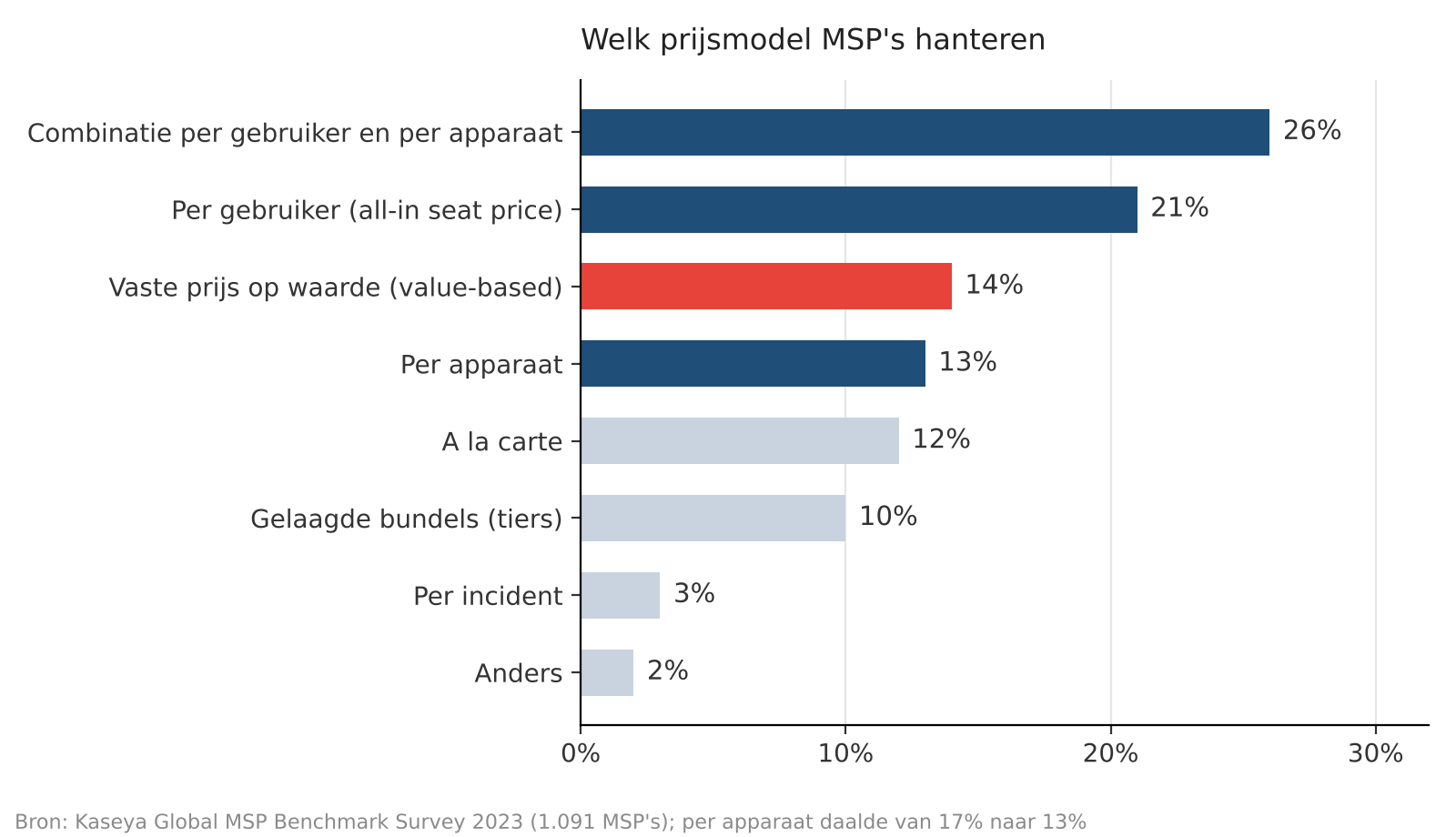
Figure 3. The combined per-user and per-device model is the most widely used; fixed value-based prices are gaining ground on per-device pricing. Source: Kaseya Global MSP Benchmark Survey 2023.
In all of these models, the per-seat price is something other than an hourly rate in disguise. The client buys three things with it: a licensing and tooling stack they would pay more for if they bought it themselves, a commitment on response and resolution times that the MSP must deliver regardless of how many tickets come in, and the transfer of risk, because a ransomware attack or an engineer walking out has become the MSP’s problem. The wage component of that price is the only part AI affects, and even there it concerns only the share of tickets that can be handled without a human. If you build the price from those three components, the client’s question changes. They still ask why they are paying, but the answer is about what they get and what they no longer have to carry themselves.
That does require knowing your cost price. ScalePad finds that 50 per cent of MSPs track direct costs per service, 44 per cent revenue per user and only 23 per cent EBITDA. An MSP that does not know its own wage cost per ticket cannot explain why AI lowers that cost by 15 per cent and the price by 0 per cent. The first step in any pricing conversation is therefore internal: what share of the €90 or €120 per seat is wages, what share licences, what share risk premium and what share margin.
Four ways to decouple the price from hours
With that breakdown in hand, there are four ways to detach the price from hours, in ascending order of how far they move from the current model.
The first is a weighted user price. Instead of one price for every employee, a user with a laptop, a phone and access to three SaaS applications gets a higher factor than a production worker with only a shared workstation. Australian MSP coach Nigel Moore calls this per user 2.0. The model keeps the invoice recognisable for the client and links the price to complexity and risk rather than to the expected number of tickets. AI gains on simple tickets barely affect this price, because it was never built on those tickets.
The second is a platform fee plus a lower per-user price. Licences, the security stack, monitoring, backup and the AI tooling itself form a fixed monthly price per client, with the service desk charged as an amount per user on top. If AI drives down service desk costs, that second amount can move without putting the whole contract up for discussion. The client can see that the AI layer costs money and that the MSP bears that cost; Kaseya finds that 13 per cent of MSPs now regard AI and automation as a significant source of revenue, against 48 per cent who name it as clients’ biggest need in 2026.
The third is outcome-based pricing within the contract. A guaranteed first response within 15 minutes, a maximum resolution time for priority 1, a patch rate of 98 per cent within seven days, an annual recovery test with report: each of those outcomes gets a price and a piece of evidence in the quarterly report. The GCIT figures show where the AI gains lie, namely in speed, and that is also what the client feels. An MSP that brings its response time down from 49 to 13 minutes sells those 36 minutes rather than giving them away.
The fourth is the most far-reaching: a component per resolved query, following the example of HubSpot and Intercom. A low fixed amount per user for the stack and the risk, plus a fixed amount per ticket the service desk handles, with a ticket resolved by AI costing less than one a technician has worked on. The model is transparent and rewards the MSP for automation, but it also shifts the volume risk back to the client, who chose a fixed price precisely to be rid of that risk. For most SME clients, this model suits part of the service, such as user queries and password resets, rather than the entire seat.
Worked example for an MSP with 1,000 seats
Worked example: what AI does to the margin of an MSP with 1,000 seats
Assumptions (fictitious, rounded): 1,000 seats at €90 per month, giving €90,000 in revenue. Costs: licences and tooling €35 per seat (€35,000), six engineers at €7,000 each all-in (€42,000), other costs €4,000. Margin: €9,000 per month, 10 per cent.
Scenario 1, AI as at GCIT: 15 per cent fewer technician hours on tickets, converted into capacity for projects or one fewer vacancy. Wage costs fall to €35,700, AI tooling costs an extra €2,000. Margin: €13,300, almost 15 per cent. The per-seat price stays at €90.
Scenario 2, a competitor undercuts by 10 per cent: the MSP follows suit at €81 to keep the client. Revenue €81,000, costs as in scenario 1. Margin: €4,300, below 5 per cent. The entire AI gain and more is gone, without a single ticket fewer being handled.
Scenario 3, the halving the client is counting on: if AI really removed half the hours, wage costs would fall to €21,000 and the margin would rise to €28,000, more than 31 per cent. That is the calculation clients make in their heads. According to the GCIT sample, 49 per cent of tickets can be handled without anyone on site, and that is not the same as half the hours; the tickets that remain are the most expensive.
Scenario 4, platform fee plus user price: the same €90 is split into €45 for the platform (stack, security, backup, AI layer) and €45 for the service desk per user. The MSP gives a 10 per cent discount on the service desk component: €85.50 per seat. Revenue €85,500, margin €8,800, almost 10 per cent. The client sees a lower price, the MSP keeps its starting margin and has a story about where the AI gain went.
What to tell the client at the next renewal
An MSP that defends its price as payment for hours loses as soon as the client or a competitor estimates those hours more cheaply, and that now happens every quarter. An MSP that builds its price from stack, risk and outcomes can pass part of the AI gain back on the component where it arises and keep the rest in its margin, with reporting that shows the client gets faster responses, shorter resolution times and a higher patch rate in return. GCIT saw its EBITDA go from 6.6 to 14.7 per cent while revenue grew by 23 per cent; and that is only possible if the price does not move in line with the hours.
For the next renewal, that means three things. Write down the cost breakdown per seat, even if it does not appear on the invoice, so that everyone at the MSP tells the same story. Choose a model in which the service desk component is visible separately and make clear that the AI layer costs money there and saves time. And with every quarterly report, provide the figures showing what that time has delivered, in minutes and in tickets handled. Clients who see that their MSP has become faster rarely ask for a lower price. Clients who only see an unchanged invoice do.
Sources Kaseya 2026 State of the MSP Report (April 2026, PDF); GCIT, AI for MSPs: seven months of our service desk data (14 October 2026); ScalePad 2026 MSP Trends Report, Financial Performance chapter; ScalePad 2026 MSP Trends Report, Customer Success + Services chapter; Kaseya, MSP Pricing: a guide to managed IT services pricing, with figures from the Global MSP Benchmark Survey 2023; ISG, Index Insider: 3Q26 ISG Index recap (October 2026); ISG Index EMEA Q3 2026, press release (12 October 2026); Diginomica on HubSpot’s shift to outcome-based pricing (April 2026); JumpCloud SME IT Trends Q3 2024, special report Your Route To Positive Client Interactions (PDF); NinjaOne, Managed services pricing strategy for 2026 (margin targets and per user 2.0).
This article was originally published in Dutch on MSP Business. Read the original →