
Almost three years after Broadcom’s acquisition of VMware, the multi-year contracts that customers signed under the new licensing model in 2024 are expiring, putting the question of where their virtual machines should run back on the table. The mass exodus predicted in 2024 has not materialised: in research by CloudBolt, 86 per cent of large VMware customers are scaling back their use, while only 2 per cent have moved three quarters or more of their environment. The workloads that did leave went mainly to the public cloud and to Hyper-V, with Nutanix the choice for larger environments and Proxmox the choice for SMEs. Broadcom cut its European partner channel back to a handful of cloud providers, prompting trade association CISPE to file a complaint with the European Commission in March 2026, and on 4 November it launched vSphere Express, a 128-core package for small environments. This article takes stock: what has changed in licensing and the channel, how many customers have really left, where their workloads now run and what MSPs have learned about migration costs, skills and backup chains. It concludes with a decision framework for small, mid-sized and large environments.
In this article: What Broadcom changed in three years | How many customers have really left? | Where the workloads ended up | What migration taught us about costs, skills and backup | Decision framework by customer size | What to do before the next renewal
For MSPs, VMware has gone in three years from a self-evident standard to a subject that comes up at every renewal. This plays out in two places at once. Customers with their own hosts receive a quote per core instead of per socket and ask their MSP whether it can be done more cheaply. MSPs that have built their own hosting platform on VMware have, since early 2026, only been able to obtain licences through a small group of selected cloud providers, which are often also their competitors. The contracts signed in 2024 for two or three years to buy time are now expiring. Some customers used that time for a migration, others to postpone one.
What Broadcom changed in three years
Broadcom completed the acquisition on 22 November 2023 and stopped selling perpetual licences on 11 December that year. Since then, VMware has only been available as a subscription per physical core, with a minimum of 16 cores per processor. The portfolio has been reduced to a few bundles, with vSphere Foundation (VVF) and VMware Cloud Foundation (VCF) the most important. VCF is the full package with storage, network virtualisation and management layer, and it is the bundle Broadcom is steering customers towards. vSphere 9 is only available in those bundles. The standalone Standard and Enterprise Plus editions remain stuck on version 8, general support for which ends on 11 October 2027. That date dictates planning for many customers, because an environment without patches is not a tenable option after that.
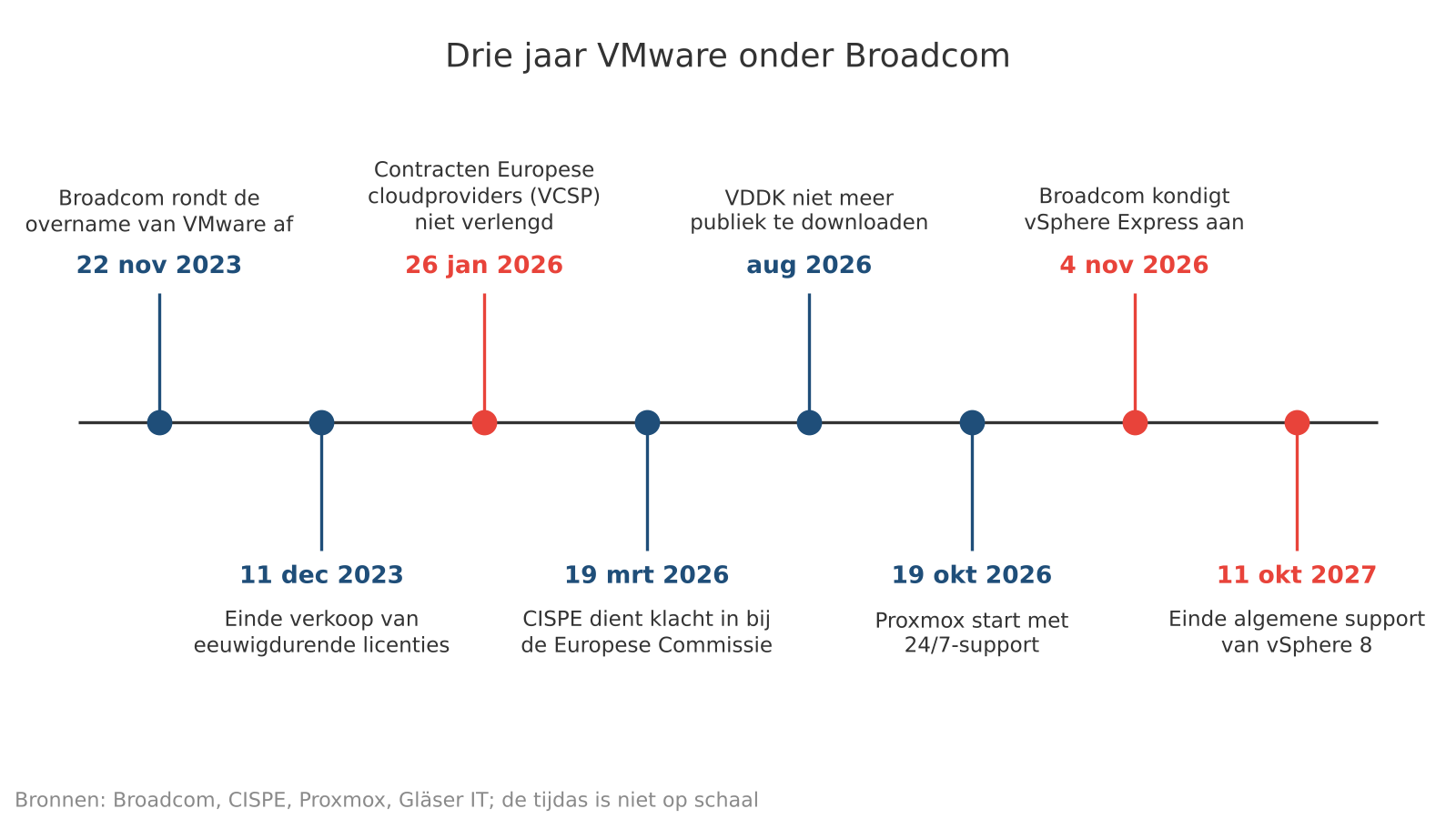
Figure 1. From the acquisition in November 2023 to the end of general support for vSphere 8 in October 2027. Sources: Broadcom, CISPE, Proxmox, Gläser IT.
The second intervention affects the channel. According to Dutch trade publication Computable, VMware had a few hundred partners in the Netherlands before the acquisition; shortly afterwards around 15 remained, and now there are at most ten authorised cloud service providers. On 26 January 2026, the contracts of European VMware Cloud Service Providers were not renewed. The programme continued by invitation only, with Copaco, Fundaments, ITQ, KPN, Proact and Uniserver among the Dutch partners holding Pinnacle status. MSPs outside that group can continue to serve their customers if they buy licences and platform from one of the remaining providers. Ludo Baauw of Intermax told Computable: ‘Then you become a kind of sales office for competitors.’
Trade association CISPE filed a competition complaint with the European Commission on 19 March 2026 and requested interim measures, including reversing the termination of the partner programme. According to CISPE, costs for some providers rose by more than 1,000 per cent. The Commission has confirmed that it is assessing the complaint, and Broadcom says it continues to invest in its European partners. In addition, a case is pending at the EU General Court in which CISPE is seeking to have the approval of the acquisition annulled. On 23 October, the Court ruled that the names of the members supporting this case will remain confidential from Broadcom. For now, there is no ruling that changes anything about today’s licences, so customers and MSPs need to plan on the basis of the current terms.

The most recent change is a step back towards the small customer. On 4 November 2026, Broadcom announced vSphere Express, a package based on vSphere 9 for customers with a maximum of 128 cores in total. It includes vMotion, High Availability and the distributed switch, but lacks DRS and vSAN. Broadcom does not publish a price. Distributor TD Synnex lists the package in the United States at $9,600 a year, which works out at $75 per core if all 128 cores are in use. According to reports from the channel, it is a fixed package with a one-year term that cannot be expanded and for which Broadcom must approve the buyer.
How many customers have really left?
The figures on departures come mainly from North America. Software company CloudBolt commissioned a survey of 302 IT decision-makers at organisations with 1,000 or more employees in January 2026. Of these, 86 per cent say they are scaling back their use of VMware. 44 per cent have migrated a quarter or more of their environment and 2 per cent are at three quarters or more. For most, the price increase is substantial but remains below the tripling that was warned of in 2024: 59 per cent saw costs rise by more than a quarter and 14 per cent saw them double. In addition, 63 per cent have changed strategy twice or more in two years.
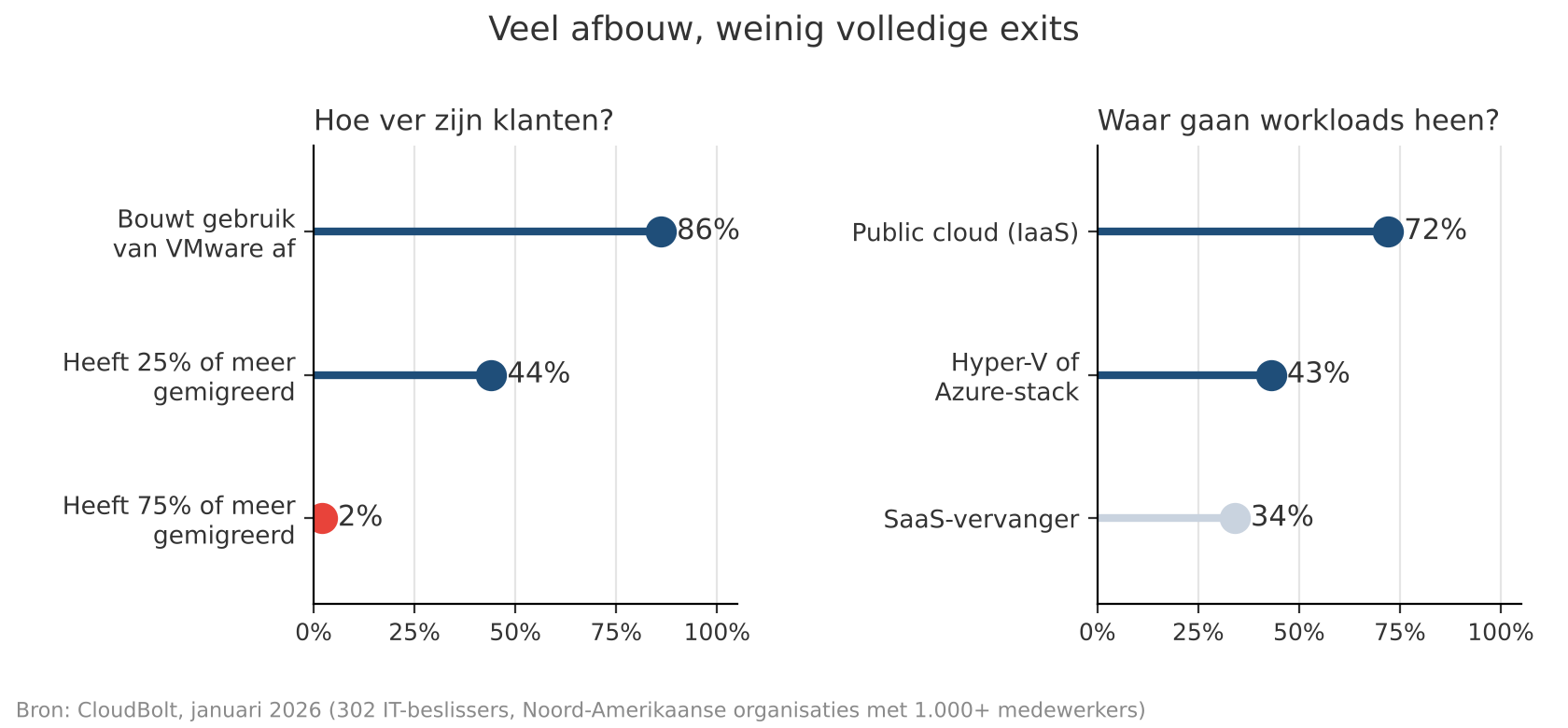
Figure 2. Almost nine in ten large customers are scaling back VMware; 2 per cent have moved three quarters or more. Source: CloudBolt, January 2026.
A second survey, conducted by Unisphere Research on behalf of support provider Rimini Street among 269 VMware users, paints the same picture. Nine in ten are considering alternatives because of licensing costs, 60 per cent are thinking about a multi-hypervisor strategy and 48 per cent currently have no plans to move workloads to VCF. The obstacles they cite are operational complexity (40 per cent), managing multiple vendors (38 per cent), the larger attack surface (37 per cent) and the skills within the team (37 per cent). Both surveys were commissioned by parties with an interest in migration and mainly measure large organisations, so for Dutch SMEs they are an indication.
Licensing adviser Redress Compliance sees the same in its own practice. Customers who had a serious exit costed out usually kept 60 to 80 per cent of their workloads on VMware afterwards. The costed plan did affect the price, however: the renewal quote fell by 20 to 50 per cent, with a median of 35 per cent. Gartner expects that around 35 per cent of current VMware workloads will be running on a different platform in 2028, and that by 2029 more than half of large organisations will have started trialling alternatives, compared with a quarter now. The picture is one of gradual scaling back workload by workload, at the pace of hardware replacement and contract dates.
Where the workloads ended up
In the CloudBolt survey, 72 per cent of organisations that are migrating cite the public cloud as their destination, 43 per cent Hyper-V or the Azure stack and 34 per cent a SaaS replacement for the application. That the cloud tops the list is consistent with a sample of large North American organisations. For Dutch SME customers with a few hosts in a server room or at their MSP, the choice is different, and there three platforms dominate the conversation.
Hyper-V is the shortest route for customers that already run Windows Server Datacenter on their hosts, because the hypervisor is included in that licence. The management tooling is familiar territory for engineers with a Microsoft background. The migration tooling is still the weak point: the conversion in System Center only works with VMs switched off, and warm migration in Windows Admin Center is a preview.
Nutanix is the choice for environments looking for a comparably integrated platform with vendor support and which are due for new hardware anyway. The company added more than 3,000 customers in the financial year to July 2026, reaching 32,360 customers and $2.55 billion in annual recurring revenue, 16 per cent more than a year earlier. CEO Rajiv Ramaswami said in April that switchers are arriving in waves and that the second wave consists of customers that first renewed with Broadcom one more time.

Proxmox is the biggest surprise of recent years. The Austrian open-source platform reports more than 2.3 million active servers, more than 60,000 organisations with a support subscription and a network of more than 3,000 integration partners. Since 19 October 2026, 24/7 support has been included in the Premium subscription, removing a commonly heard objection to production use. For MSPs, Proxmox has therefore also become a channel story, because partners sell the subscription and provide the migration and management around it. Dutch IT service provider Bossers & Cnossen reported in early 2026 that it had migrated four customers from VMware to Proxmox, with savings running into tens of thousands of euros a year.
What migration taught us about costs, skills and backup
The licence bill is the easiest part of the sum. At the list prices of a German reseller from September 2026, VCF costs €362.24 per core per year and VVF €192.75. The most expensive Proxmox subscription costs €1,100 per socket. For a small environment of three hosts with 96 cores in total, that comes to almost €35,000 for VCF, €18,500 for VVF and €3,300 for Proxmox Premium. For an environment of 1,024 cores, the difference with VCF rises to more than €300,000 a year. These are list prices, and large customers negotiate considerably lower per-core rates. Nutanix and Hyper-V are missing from the comparison because there is no comparable public per-core price for them.
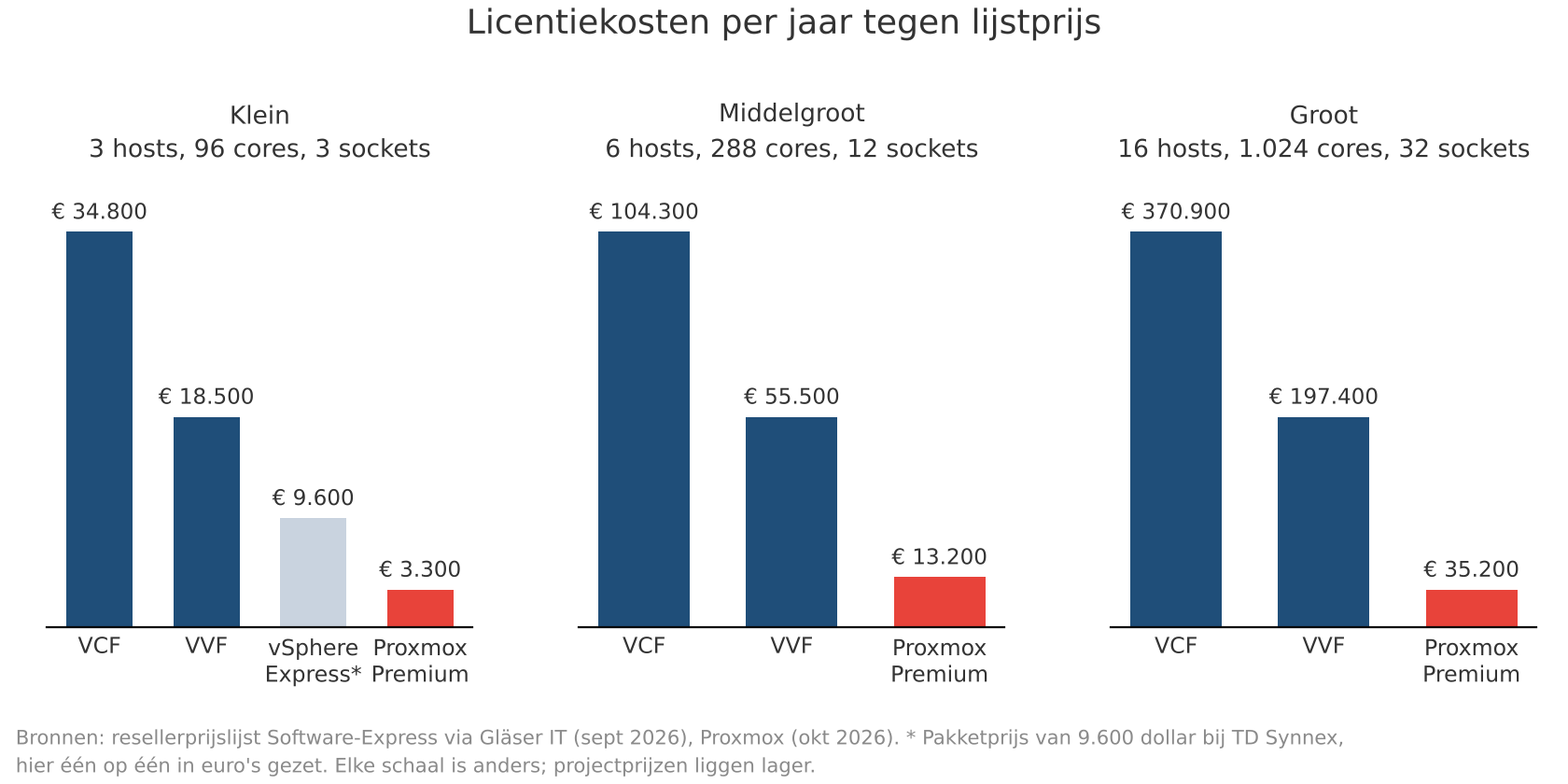
Figure 3. At list price, VCF costs roughly ten times as much as the most expensive Proxmox subscription at every size; vSphere Express only exists up to 128 cores. Sources: Software-Express via Gläser IT, Proxmox, TD Synnex.
The rest of the bill lies in the project. A migration requires an inventory, a pilot, migration waves and a period in which two platforms run side by side, and with Nutanix often new hardware as well. German publication Cloudmagazin estimates 12 to 18 months for a switch to Nutanix for an environment of 300 cores, and six to 12 months for Proxmox, depending on in-house expertise. Then there is the tooling. The Proxmox import wizard copies a VM while it is switched off, so downtime grows with disk size. Tools that can transfer a running VM often rely on VDDK, VMware’s library for reading disks, and since August 2026 it has no longer been publicly available for download. Existing installations continue to work, while a new migration appliance needs a fresh copy.
The second lesson concerns skills. In the Unisphere survey, 37 per cent cite the team’s skills as an obstacle and 40 per cent operational complexity. An engineer with ten years of experience in vCenter starts over on Proxmox with Linux, Ceph and ZFS. An MSP that chooses a different platform for each customer has to maintain three kinds of expertise with the same headcount. The practical consequence is that an MSP chooses one alternative as its standard alongside VMware and builds documentation, monitoring and automation around it. A multi-hypervisor strategy is popular with customers in the surveys, but for the MSP it means double runbooks.
The third lesson is that the backup chain moves too. Backup jobs that work via VMware’s APIs stop at the moment of the switch, and the first backup on the new platform is a full one. That temporarily requires extra storage in the repository, and the old restore points must remain recoverable throughout their entire retention period. Veeam, the standard at many MSPs, has since version 13.1 at the end of July 2026 been able to restore backups of VMware VMs to Proxmox, Nutanix AHV and Hyper-V, adding the necessary VirtIO drivers in the process. Replication between different hypervisors is not available, so a failover site still running on VMware cannot receive replicas from the new platform. Furthermore, the contents of a virtual TPM do not move with the disk, so BitLocker recovery keys must be secured before the switch. A restore test on the target platform therefore belongs in every migration wave, before the old environment is switched off.
Decision framework by customer size
Which platform suits which customer?
Three factors determine the choice: the customer’s number of cores, the expertise the MSP has in-house and the dates on which the contract and hardware expire.
Small, up to 128 cores (two or three hosts): VCF and VVF are expensive for these customers relative to what they use. vSphere Express is worth considering if the customer stays within 128 cores, does not need DRS or vSAN and is approved by Broadcom. Expect a one-year contract and a price that may change at renewal. The alternative is Proxmox with a Standard or Premium subscription, or Hyper-V if the Windows Server Datacenter licences are already in place. As an MSP, choose one of the two as the standard for all small customers. For customers running mainly standard applications, moving to the MSP’s hosting platform or to SaaS is often cheaper than new hosts.
Mid-sized, 128 to around 500 cores: This is where a partial exit pays off most. Move test, development and simple Linux and Windows servers to the chosen alternative at the next hardware refresh, and keep VMware for applications whose vendor only supports vSphere. Fewer cores under contract directly lowers the bill, and a costed exit plan delivered a median reduction of 35 per cent on the renewal quote for Redress Compliance’s customers. If the environment runs on vSphere 8, schedule the final wave before October 2027.
Large or regulated, from around 500 cores: VCF is defensible if the customer uses the entire stack, including vSAN, NSX and the automation. If the customer only uses the hypervisor, Nutanix is the alternative that stays closest to the existing way of working, with a lead time of a year or more. In both cases, lock in the price for several years and factor the requirements of the Cyberbeveiligingswet, the Dutch implementation of NIS2, and DORA on supplier risk and exit strategy into the decision.
The MSP’s own platform: An MSP without Pinnacle status buys VMware from a cloud provider that is also a competitor. Calculate what the margin per VM would then be, and whether an in-house platform on Proxmox or Nutanix, with the existing backup and monitoring tooling, is feasible within the term of current customer contracts.
What to do before the next renewal
In three years, then, the MSP’s customers have rarely left in one go. They have shrunk on VMware, added a second platform or renewed their contract with the intention of doing things differently next time. That intention is now due. The 2024 contracts are expiring, vSphere 8 has eleven months of general support left and, with vSphere Express, Broadcom has shown that it wants the small customer back, on its own terms.
Sources CIO.com on the CloudBolt survey of 302 IT decision-makers (February 2026); The Register on the Unisphere Research survey commissioned by Rimini Street (7 October 2026); Computable, Anger among cloud and service providers over new Broadcom/VMware cull (10 February 2026); CISPE, press release on the competition complaint against Broadcom (19 March 2026); Proxmox, press release on 24/7 support and Proxmox North America (2 September 2026); Gläser IT, timeline and reseller prices for VMware licences (October 2026).
This article was originally published in Dutch on MSP Business. Read the original →