Sovereign cloud has moved from a political topic to a procurement requirement. On 3 July the Dutch cabinet adopted a revised central government cloud policy that in principle keeps email and documents out of the public cloud, is building a government cloud of its own and has signed a framework agreement with Germany’s STACKIT. In research by Whitelane and Eraneos, 45 per cent of public sector organisations expect to scale back their use of US hyperscalers, while 40 per cent say the sovereign variants offered by those providers do not meet their requirements. Microsoft and AWS have meanwhile delivered: in January AWS opened a separate European cloud in Brandenburg, and in October Microsoft extended its Sovereign Cloud with key management on the customer’s own hardware. In a quote, the word sovereign breaks down into three questions: where is the data, who operates the service, and which law governs the provider? The European Commission has drawn up a five-level scale for this. This article shows what government, healthcare and education are asking for, what US and European providers deliver on each of those three points, and what role the MSP plays as the party that joins both worlds together for the customer.
In this article: What the government has laid down | What customers say and what they do | Data, operations and jurisdiction are three different questions | What Microsoft and AWS deliver | How mature are the European providers? | Six questions for the quote | Where the MSP becomes the integrator
A municipality, hospital or school group requesting a quote today increasingly includes a sentence on sovereignty. What that sentence means differs from one request to the next. One customer wants its data to be in the Netherlands, another wants no administrator outside Europe to have access, and a third wants to be sure a US court can never demand it. Those are three requirements with three different price tags, and as an MSP you do well not to confuse them, or you will promise too much or bid too high. It helps that the Dutch government has this year written down what it means itself.
What the government has laid down
The revised central government cloud policy of 3 July 2026 replaces the 2022 policy and is stricter in three respects. One general principle: every central government organisation must set out in its own cloud strategy when cloud is preferred. For substantial cloud use, a risk analysis is mandatory that also weighs geopolitical risks, foreign jurisdiction and market concentration, together with an exit plan that describes both a planned transition and an unexpected interruption and is tested annually. And email and documents may not be processed in the public cloud unless there is an independently established necessity, a tested risk analysis and approval from the minister. All information must stay within the European Economic Area plus Switzerland, and key management for confidential data preferably sits outside the cloud provider.
The policy applies to central government. Independent administrative bodies are expected to follow it, and other government bodies are advised to do so. The transition period for existing use is four years, and twelve months for an exit plan for existing services. The document also mentions the wish of the Tweede Kamer (the Dutch House of Representatives) that by 2029 at least 30 per cent of central government cloud storage and applications will be hosted on Dutch-European soil. No extra funding has been promised, so implementation must come out of existing budgets.
The cabinet is also opting for a sovereign government cloud of its own. State Secretary Eric van der Burg wrote to the Kamer on 2 July that it will be built under central direction, preferably in central government data centres, on open source and a container platform following the Haven standard. The design will be tested in a pilot set-up, and the first applications should be able to run on it by the end of this year. The exploratory study that preceded it sets out the starting point: Amazon and Microsoft together hold 70 per cent of the European cloud market, while European providers each hold roughly 2 per cent. In April, the central government procurement body SLM Rijk had already signed a framework agreement with STACKIT, the cloud of Germany’s Schwarz, the parent company of Lidl. It stipulates that data stays within the European Economic Area and that central government can exit if STACKIT acquires an owner from outside Europe. A comparable agreement with OVHcloud is under investigation.

What customers say and what they do
The market is following, with some hesitation. For their annual IT Sourcing Study, Whitelane Research and Eraneos surveyed more than 350 Dutch organisations. In the public sector, 45 per cent expect to scale back their use of AWS, Microsoft Azure and Google, from minor adjustments to a major phase-out, while 12 per cent want to expand it. A third (32 per cent) expect to make substantially more use of European, private or in-house data centres. Opinion is divided on the sovereign variants of the US providers: 40 per cent say they do not meet their requirements, 28 per cent think they do and 32 per cent do not know what is available. On each of the three questions, more than a quarter have yet to choose a direction.
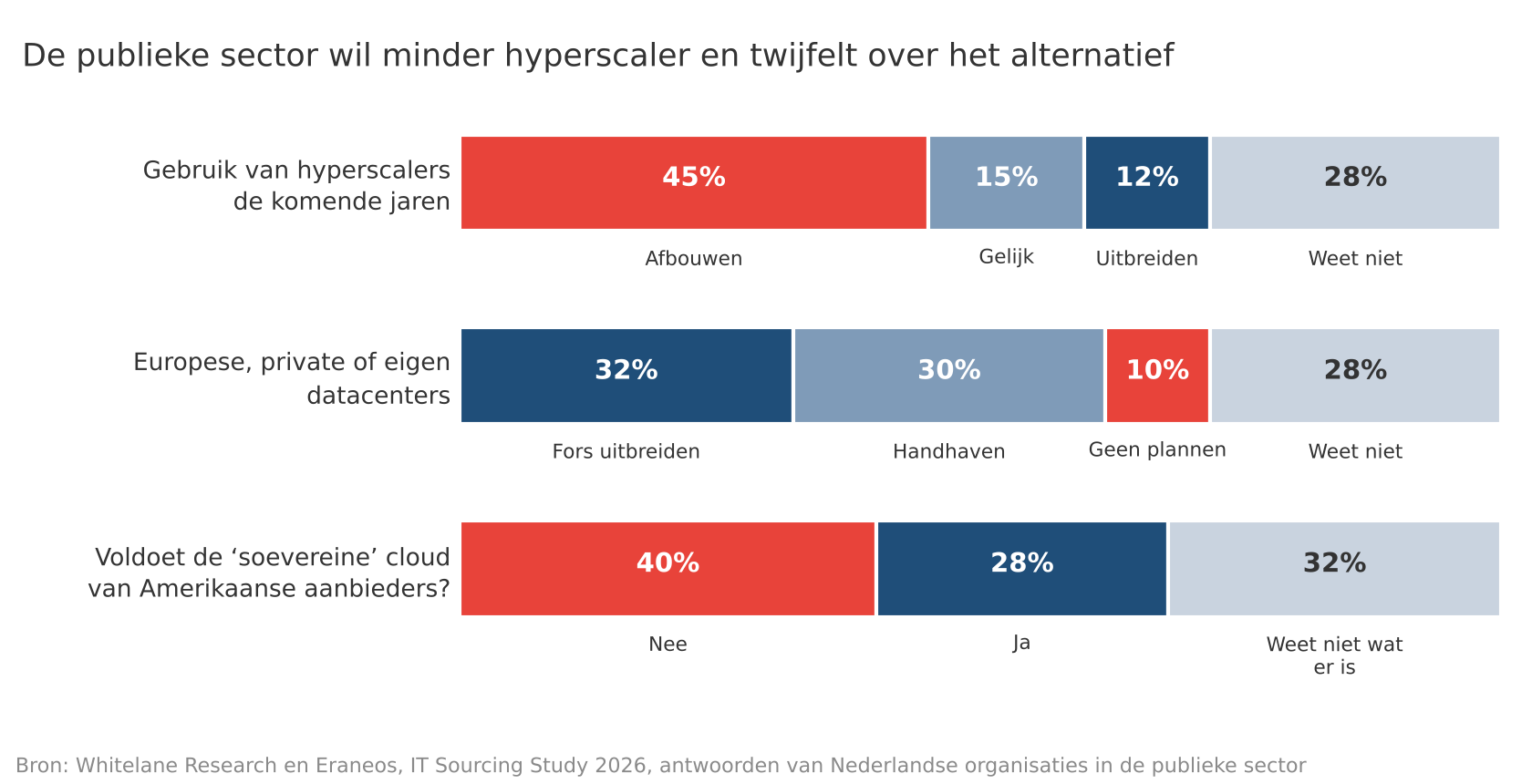
Figure 1. Almost half of the public sector wants to scale back its use of hyperscalers; more than a quarter do not yet know. Source: Whitelane Research and Eraneos, 2026.
Outside government, the gap between wanting and doing is wider. In the Data & AI Monitor from Xebia and Data Expo, 85 per cent of organisations in the Benelux believe Europe should present a stronger front against US technology companies. Fifteen per cent have taken concrete steps towards sovereign or European infrastructure, and for 42 per cent the subject is not on the agenda. For an MSP with mainly commercial SME customers, sovereignty is therefore, for now, a question for a minority. In the public sector, healthcare and education, the picture is different.
That is where the first projects are visible. SURF, the ICT cooperative for education and research, expanded its pilot of a sovereign digital workplace this spring and is looking for a solution for the 80,000 users of SURFdrive. Cloudwise announced a partnership with Nextcloud for more than 4,500 primary schools, and Centric and KPN offer municipalities managed workplaces in Dutch data centres. Bernhoven hospital, with ilionx and Uniserver, moved patient data into a private cloud that falls entirely under Dutch and European law. In all these examples, a service provider sits between the institution and the platform.
Data, operations and jurisdiction are three different questions
In practice, what a customer means by sovereign falls into three layers. The first is data: where are the data, the backups and the metadata, and who holds the keys? The second is operations: who manages the service, from which country, and can that party shut the service down? The third is jurisdiction: which law governs the provider and its parent company, and can a foreign government demand data or prohibit delivery? The first layer is easy to address with a European region and your own keys. The third depends on who owns the provider, and technology alone can only mitigate it.
In October 2025 the European Commission worked out these layers in the Cloud Sovereignty Framework. It assesses a cloud service against eight objectives, including strategic, legal and operational sovereignty, data and AI, the supply chain and technological openness. Each objective receives a level from SEAL-0 to SEAL-4, and the lowest level counts as the final rating. The supply chain carries the most weight in the score, at 20 per cent. The framework is an assessment method, not a certificate, and the Commission invites other buyers to use it.
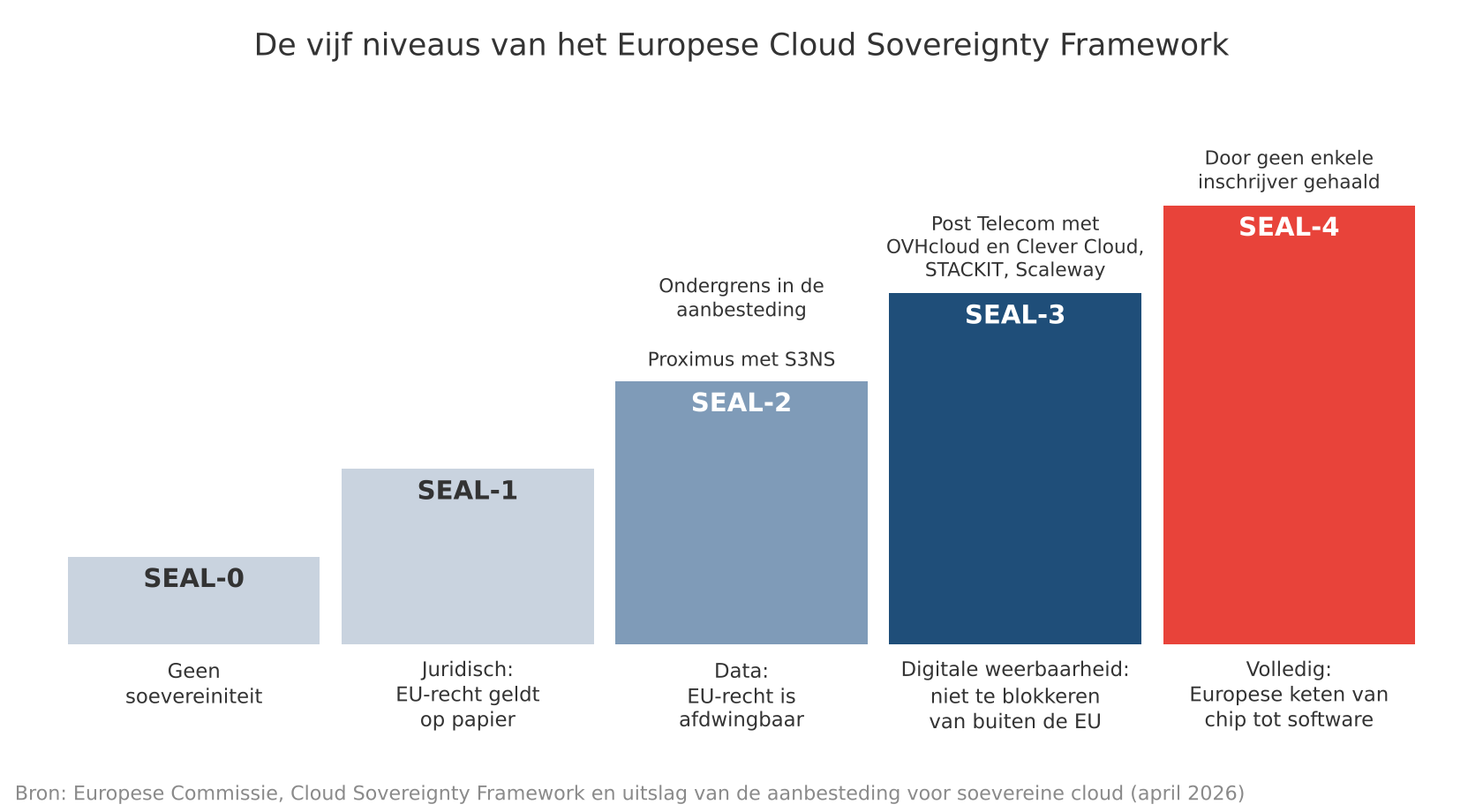
Figure 2. The Commission required at least SEAL-2; three of the four winning bidders reached SEAL-3 and none reached SEAL-4. Source: European Commission, April 2026.
The Commission applied the framework itself in a tender worth up to €180 million over six years, awarded in April 2026. The minimum was SEAL-2, the level at which European law is enforceable while substantial dependencies outside the EU remain. Three of the four winners reached SEAL-3, which means their service cannot be blocked from outside the EU: Luxembourg’s Post Telecom (with OVHcloud and Clever Cloud), STACKIT and Scaleway. The consortium of Proximus with S3NS, which runs on Google technology, reached SEAL-2. SEAL-4, a fully European chain from chip to software, was reached by no one.
What Microsoft and AWS deliver
The two largest US providers have chosen different designs. On 15 January 2026 AWS opened the AWS European Sovereign Cloud, a separate cloud with a first region in Brandenburg that is physically and logically separate from the other AWS regions. It is operated by EU residents through German companies, with an investment of €7.8 billion and roughly ninety services at launch. AWS announced local zones in Belgium, the Netherlands and Portugal, and reported that on 24 October it demonstrated in an exercise that the environment can keep running without infrastructure outside the EU.
Microsoft builds sovereignty in layers on top of the existing cloud. In the Sovereign Public Cloud, a European partner called Data Guardian supervises remote access by Microsoft engineers, with a log that cannot be altered after the fact. Since October, customers have been able to keep their encryption keys on their own hardware outside Microsoft. For organisations that want to go further, there is the Sovereign Private Cloud on Azure Local, with a local version of Microsoft 365 and the ability to keep working without a connection to Microsoft.
On the data and operations layers, both providers go a long way, and the third layer remains open. In June 2025 Microsoft France acknowledged to a committee of the French Senate that it could not guarantee that data of French public bodies would never be handed to US authorities, because the company falls under the US CLOUD Act. This spring Microsoft’s Benelux CTO told ITdaily that the company cannot comply with such a request if the customer manages the keys itself. Technically that holds for stored data, and legally the parent company remains American. In the Whitelane and Eraneos research, this is the point at which 40 per cent of the public sector drops out.
How mature are the European providers?
The European providers have the opposite profile. On jurisdiction, STACKIT, OVHcloud, Scaleway, IONOS and T-Systems’ Open Telekom Cloud are strong, and for compute, storage and managed Kubernetes clusters they are a fully fledged alternative. The gap lies in the layers above. The municipality of Nijmegen had T&T Dataconsultancy compare five European cloud providers on 24 criteria, and concluded that the differences rarely lie in storage or compute and mainly in governance, access management and the maturity of managed services. The research accompanying the government cloud study calls the functional gap between European alternatives and the US hyperscalers currently too large to ignore.
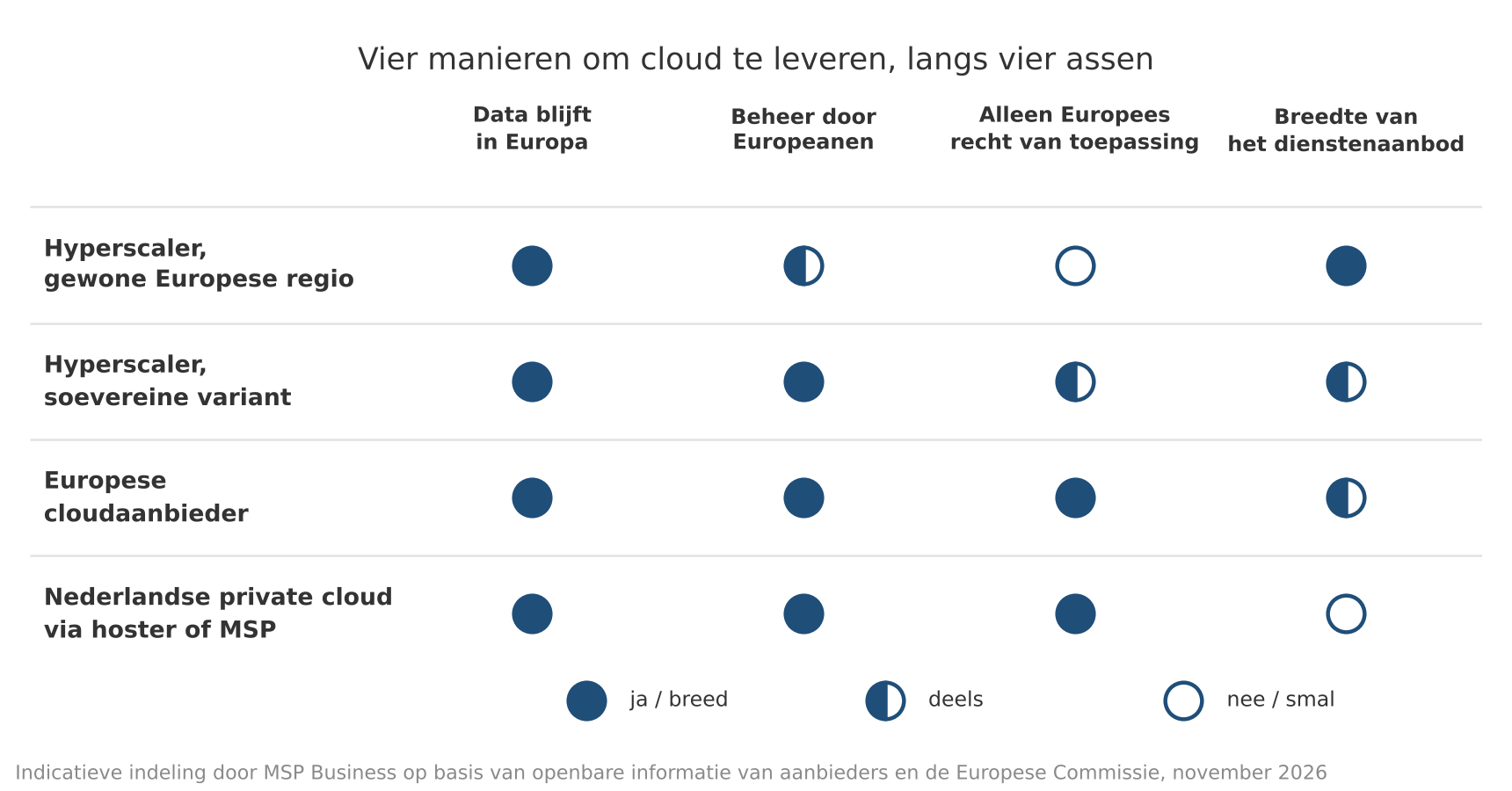
Figure 3. Each delivery model scores on a different axis; the sovereign variant of a hyperscaler and the European provider are approaching each other from two sides. Indicative classification by MSP Business.
Estimates differ on how much of the work can move to Europe, and they come from parties with an interest. In January, Wido Potters of the Dutch provider BIT told Kamer members that Dutch cloud companies can deliver 80 per cent of what US providers now deliver in storage, software and email. The Dutch director of T-Systems said that 60 to 70 per cent of a government organisation’s workloads can stay with a hyperscaler without objection. Both statements can be true at the same time. They point to the need to answer the question workload by workload.
The workplace is where the alternative is least settled. Microsoft 365 is the standard at most customers, and a move to Nextcloud or a comparable suite affects every employee. That explains why central government policy applies a four-year transition period to email and documents, and why institutions such as SURF start with pilots. A Dutch private cloud, too, is rarely free of non-European technology: the central government study notes that Dutch and European cloud services often run software from outside Europe.
Six questions for the quote
Six questions that make sovereignty concrete in a quote
1. Which data requires which level? Classify the customer’s workloads by sensitivity. A public website and a patient record do not need to sit on the same platform, and this classification makes the requirement affordable.
2. Where are data, backups and metadata? Record the location for all three, and for log files and support data as well. State who manages the encryption keys and where they are held.
3. Who has access, and from which country? Describe who has administrative access at the cloud provider and at the MSP itself, with which tools and under what supervision. Include the MSP’s own management tools.
4. Which law governs the chain? State the country of establishment of the provider, the parent company and the main subcontractors, and what happens contractually if ownership changes.
5. What happens if the service stops? Supply an exit plan for a planned transition and for a sudden interruption, and agree that it will be tested annually.
6. Which dependencies remain? No provider reached the highest European level. Write down which technology from outside Europe underpins the service, so that the customer knows and accepts the residual risk.
Where the MSP becomes the integrator
It follows that most customers will work with a mixed environment in the coming years. For now the workplace stays with Microsoft, possibly with their own keys and European oversight, the most sensitive data moves to a European or Dutch cloud, and at every renewal the question returns whether something can move. Someone has to design that environment, manage identities across both platforms, arrange backup outside the primary provider and keep the exit plan up to date. For institutions without their own architects, that is the MSP.
Three preparations go with this. The first is knowledge of at least one European platform alongside Azure, preferably one for which the customer already has a procurement framework. The central government framework agreement with STACKIT allows purchasing through local service providers. The second is an answer of your own to the third question in the framework. Many MSPs manage their customers with software from US vendors, and a customer that takes sovereignty seriously will sooner or later ask who can reach its environment through the MSP’s management platform. The third is a price. The mandatory risk analysis, the classification of workloads and the annually tested exit plan from central government policy are tasks that the customer can rarely carry out itself and that the MSP can offer as a service.
Sources Rijksoverheid, Herziening rijksbreed cloudbeleid 2026 (3 July 2026); Digitale Overheid, Overheid zet in op eigen, veilige soevereine cloud (2 July 2026); Binnenlands Bestuur on the IT Sourcing Study by Whitelane and Eraneos (6 March 2026); European Commission on the sovereign cloud tender and the SEAL levels (17 April 2026); AWS, press release on the AWS European Sovereign Cloud (15 January 2026); ITdaily on the expansion of Microsoft Sovereign Cloud (October 2026).
This article was originally published in Dutch on MSP Business. Read the original →