
Almost two thirds of business telephony in the Netherlands runs in the cloud, putting the country ahead of the rest of Europe. For SMEs, calling has become a software service that increasingly lives in the same environment as Microsoft 365 and the workplace. Those same SMEs have largely outsourced their IT, so the question of whether the MSP also handles telephony is an obvious one. There is still no public figure for that share in the Netherlands. The data that does exist shows a divided market. Telecoms partners and hosted voice specialists still serve a large proportion of customers, while operators and platform vendors are explicitly courting MSPs as a sales channel. For the MSP, it is a choice that affects margins, customer loyalty and responsibility for availability.
In this article: How common is cloud telephony in the Netherlands? | Have SMEs already handed their IT to a service provider? | What share of telephony goes through the MSP? | Why are vendors courting MSPs now? | What does this mean for the MSP?
The fixed line itself is a shrinking market. The Dutch regulator ACM counted 3.63 million fixed telephony lines actually used for calls in the second quarter of 2026, 1.77 per cent fewer than a quarter earlier. The number of call minutes fell by 7.43 per cent to 800 million over the same period. These figures cover consumers and businesses combined. For the business market alone, Telecompaper reported a revenue decline of just over 4 per cent in fixed telephony for the first quarter of 2026, and the research firm expects a contraction of almost 4 per cent a year up to and including 2030.
Meanwhile, virtually every business with a reception desk, a scheduling function or a service desk wants to remain reachable on a fixed number. The value lies less and less in the line itself and more and more in the software around it, such as hunt groups, call queues, CRM integrations and the app on the employee’s phone. That is territory where the MSP feels at home.
How common is cloud telephony in the Netherlands?
Research firm Cavell tracks the cloud communications market in six countries and has ranked the Netherlands top in Europe for years. In its June 2025 market reports, Dutch penetration came in at just under two thirds of business users. The United Kingdom stood at 57 per cent, Germany at just over a fifth and France at less than a quarter. In its April 2026 edition, Cavell describes the Netherlands, together with the United States, as a market in the late stage of adoption, with little room left for growth through new users.
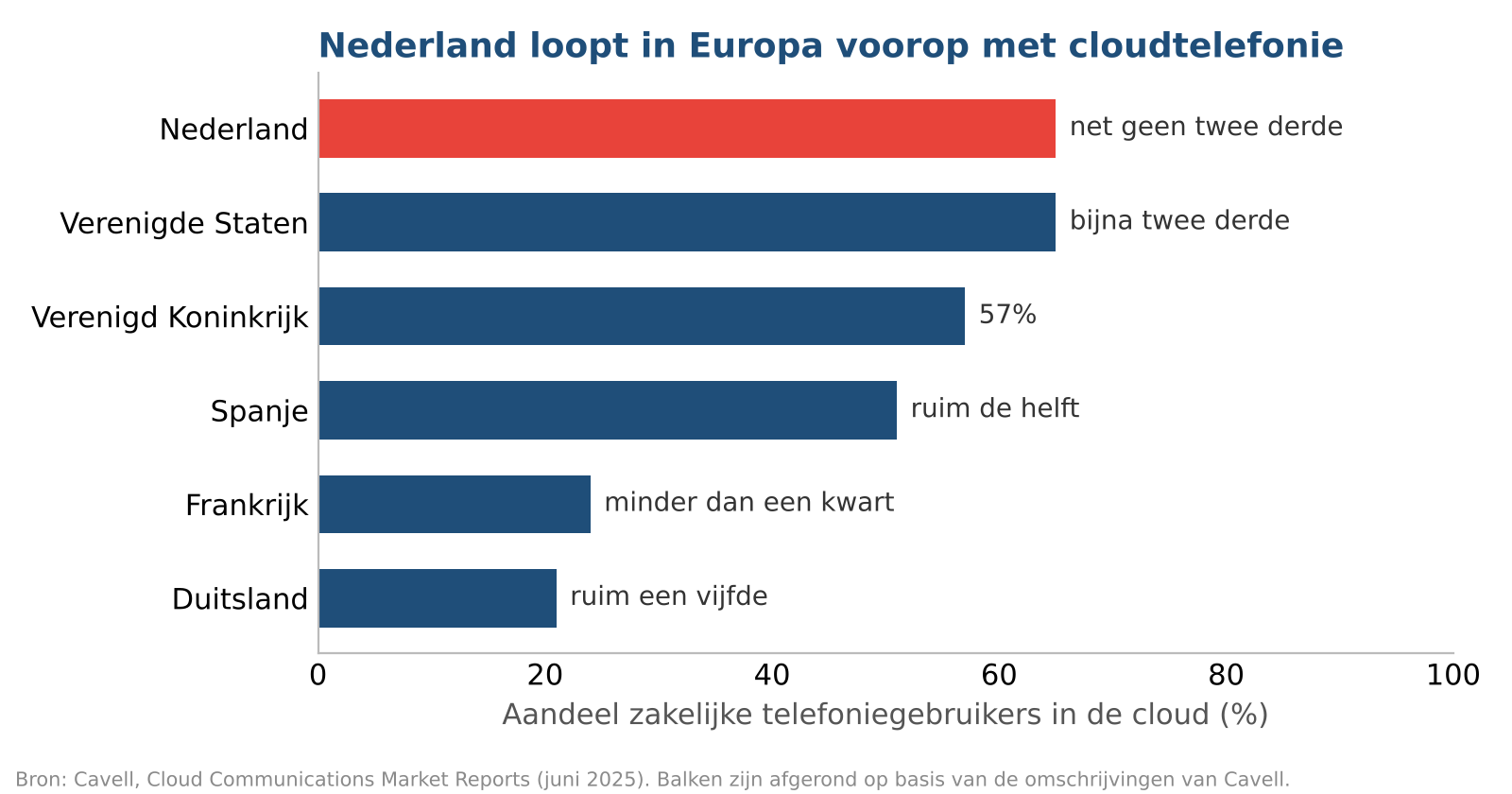
Figure 1. Share of business telephony users in the cloud by country. Source: Cavell, June 2025, rounded values.
That lead is long-standing. By the end of 2015, Cavell had already counted 820,000 hosted voice users in the Netherlands, noting at the time that it was mainly businesses with ten to fifty workstations that were making the switch. SMEs were therefore the first group to get rid of their phone systems.
For the MSP, this has a practical consequence. A new SME customer rarely still has a PBX in the meter cupboard. Instead, there is a subscription with a cloud provider, often with its own contract term and its own contact person. Cavell is seeing a growing number of switches from one cloud platform to another in the Netherlands. Such switches are the natural moment for the IT partner to have a say in the choice.
Have SMEs already handed their IT to a service provider?
Outsourcing is the norm in the Netherlands. According to Eurostat, 84 per cent of Dutch businesses with ten or more persons employed had ICT functions performed wholly or partly by external suppliers in 2024, compared with an EU average of 72 per cent. Figures from Statistics Netherlands (CBS) for businesses with 2 to 250 persons employed show 35 per cent fully outsourcing their ICT work and 24 per cent doing so partly.
In 2023, the Digital Trust Center, a Dutch government body, looked specifically at the smallest businesses. In a benchmark of 766 freelancers and SMEs with up to 25 employees, 73 per cent of businesses with three to five employees had an external IT service provider. Among those with six to ten employees the figure was 66 per cent, and among the very smallest 47 per cent.
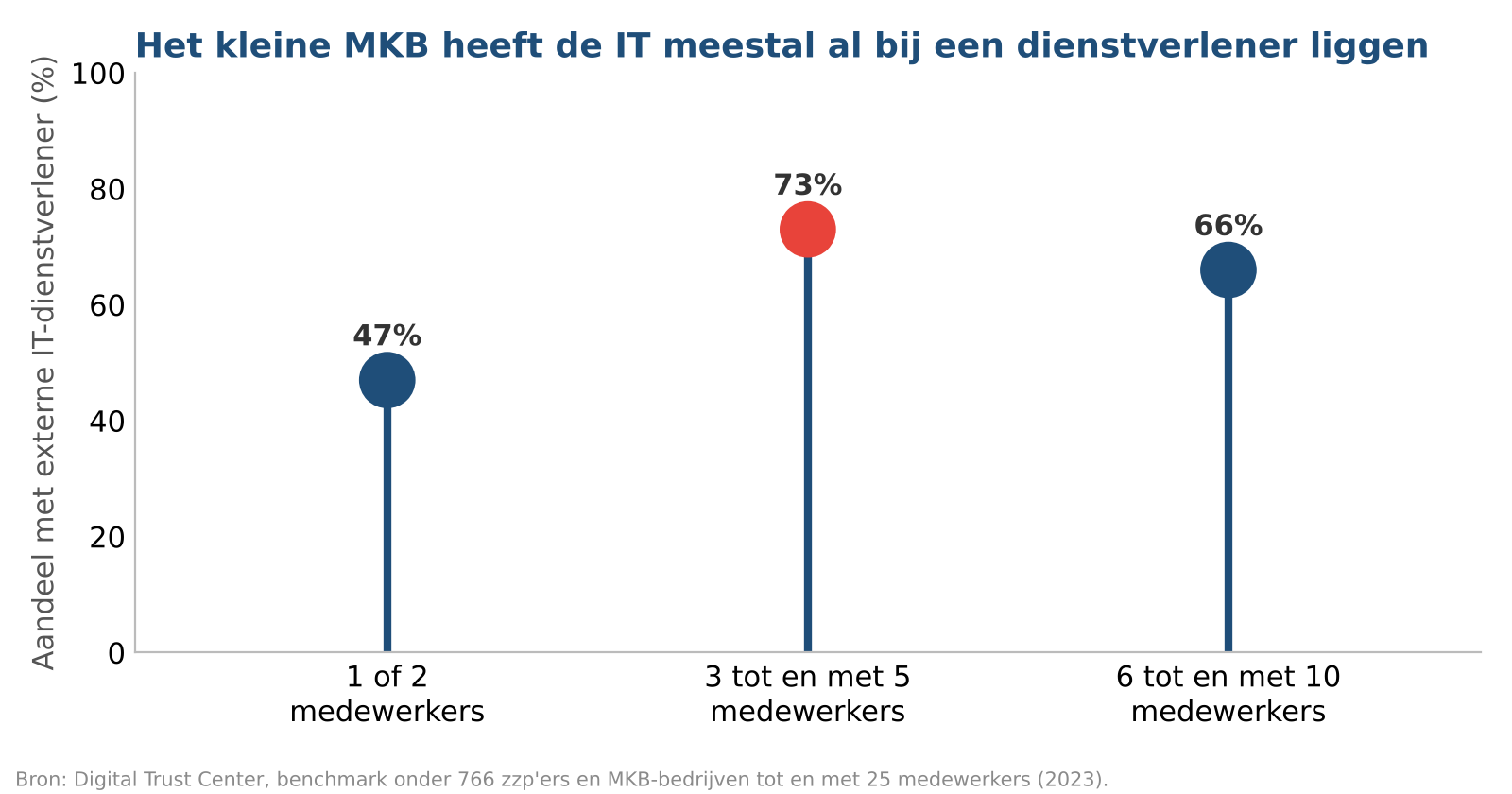
Figure 2. Share of small businesses with an external IT service provider, by company size. Source: Digital Trust Center, 2023.
So for the majority of SMEs, the IT service provider already has a seat at the table. Whether telephony is also part of that contract is another question.
What share of telephony goes through the MSP?
This is where the statistics run out. The ACM and Telecompaper measure the market by provider and by service, and make no distinction according to the channel through which a customer buys its telephony. A Dutch figure for the share of SMEs that arrange telephony through their IT partner is not publicly available anywhere.
What is clear is that most of the market runs through partners. Cavell estimates that more than 70 per cent of communications technology is sold through the channel. KPN mentions 2,000 business partners on its own website, and Enreach reports more than 4,500 partners and almost 3 million users in Europe. These numbers include a mix of telecoms resellers and IT service providers. At the end of 2019, Telecompaper found that smaller hosted VoIP providers together supplied 25.7 per cent of business fixed lines, while KPN stood at just over 53 per cent. More recent figures are behind paid reports.
International research among MSPs gives an indication from the other side. In 2023, Datto surveyed more than 1,500 MSPs, including 154 in the Benelux, and found that VoIP telephony features in portfolios more often in Europe than in other regions. A poll by CRN in Australia for wholesaler Access4 showed how thin that offering can be in practice. Of the MSPs surveyed, 65 per cent sold telephony to fewer than half of their customers, while 70 per cent said demand for hosted communications was high. Just over 40 per cent saw no business case in it and around a quarter considered the margin too slim.
In Kaseya’s latest State of the MSP report, with 1,061 respondents, telephony does not even appear as a category in the overview of managed services offered. Back-up stands at 79 per cent, endpoint and network management at 73 per cent and security at 72 per cent.
Taken together, the picture is that telephony through the MSP is common among SMEs but not yet a standard part of the managed contract. It seems likely that a sizeable share of customers have a separate telephony supplier alongside their IT partner, or buy both services from a single party under two contracts with two invoices.
Why are vendors courting MSPs now?
Telecoms providers are seeing their traditional revenue decline. Telecompaper reported in January that mobile revenue in the SME segment fell by 3.2 per cent in the third quarter of 2025. The firm points to pressure from new providers. According to Telecompaper, players such as Enreach were the only ones to see their revenue in the business mobile market grow for two consecutive quarters, while the three network operators lost revenue.
In the United Kingdom, Gamma describes the same trend. According to Will Morey, managing director of Gamma Business, IT companies are adding telephony and MSPs would prefer to source voice, security, mobile and data from a single supplier. His advice to partners is to treat telephony as risk management rather than as a product sale.
Microsoft is the third force in this arena. At the end of 2025, Teams Phone had 26 million users with a phone number worldwide, up from 20 million in April 2024. Cavell analyst Patrick Watson calculated that this represents roughly 6 per cent of the more than 350 million Teams users. Many of them rarely make external calls, and the licensing costs make an organisation-wide roll-out hard to justify. This spring, Cavell revised its growth forecast for Microsoft downwards in every country it covers.
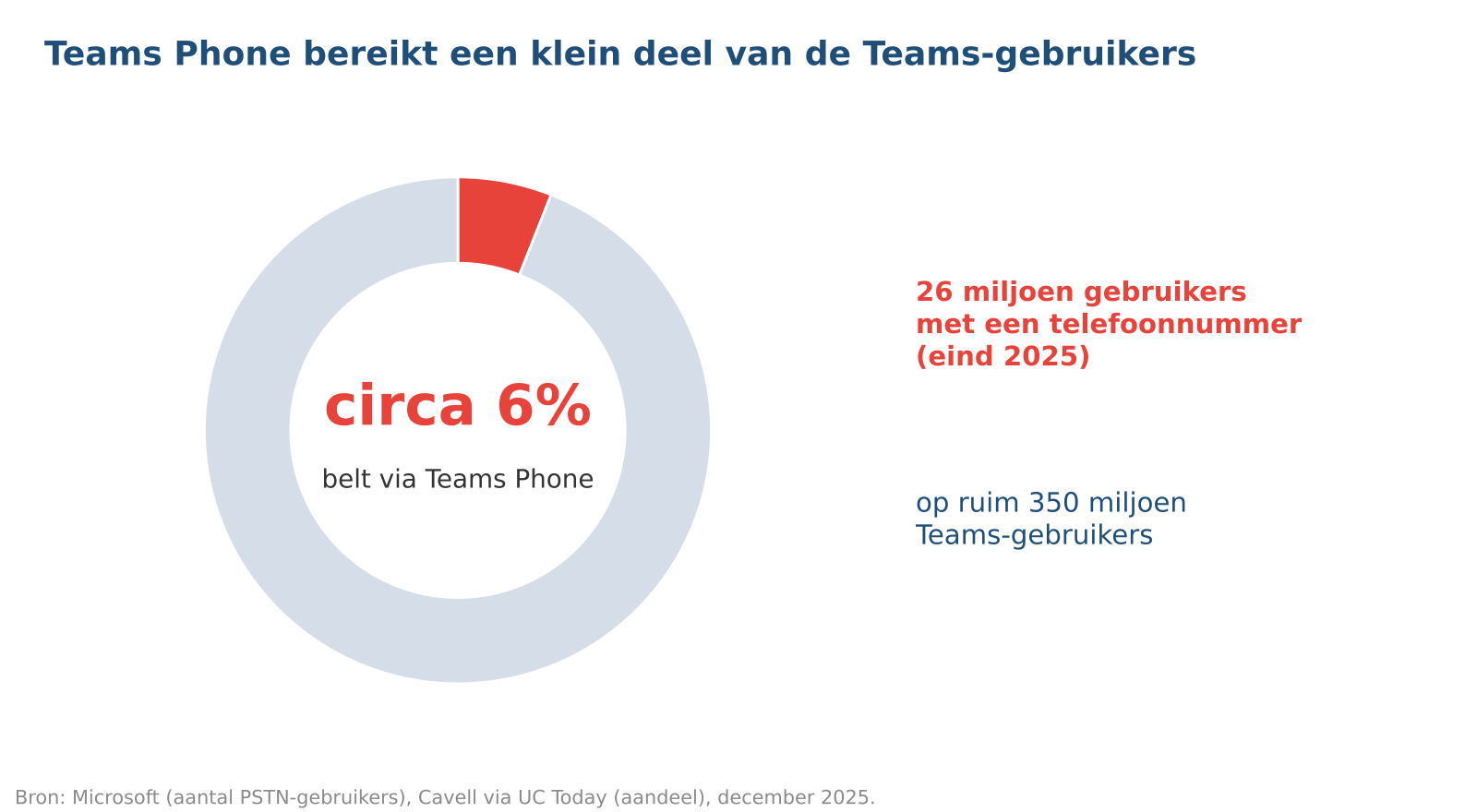
Figure 3. Teams Phone users with a phone number as a share of all Teams users. Source: Microsoft and Cavell via UC Today, December 2025.
Even so, for the MSP that manages a customer’s Microsoft 365 tenant, Teams Phone remains the shortest route. Licences, identities and devices are already under its management, and the phone number is simply added as an extra service.
What does this mean for the MSP?
The revenue per workstation is modest. Morey points out that MSPs often spend far more each month on packages such as Salesforce or HubSpot than on telephony, which means integration with other systems carries more weight than the calling features themselves. For the MSP, the value lies in the overview: a single point of contact, a single invoice, and an outage that can be investigated by the same party from the network through to the calling platform.
With the revenue comes responsibility. Availability is business-critical for most customers, number porting during a switch requires planning, and a telephony outage is immediately felt by the customer’s own customers. Many MSPs are also familiar with the situation in which SMEs call their IT partner anyway when a Teams environment is playing up or a connection has dropped, even if the invoice comes from someone else.
Four routes to delivering telephony
- Teams Phone. The customer makes calls from Teams. The numbers and call traffic come from an operator via Operator Connect or Direct Routing, or from Microsoft itself via a Calling Plan. Suits customers who already work entirely in Microsoft 365.
- White-label hosted voice. You deliver a cloud PBX under your own brand, running on a wholesale provider’s platform. In the Netherlands, Dstny, Enreach, Gamma and KPN Partner Network, among others, offer such a model. Suits customers with a reception desk, hunt groups or desk phones.
- Your own PBX in the cloud. You manage PBX software such as 3CX yourself and buy numbers and call traffic via a SIP trunk. This gives the most freedom but also places the most management on your shoulders.
- Referral with agreements. You leave telephony with an established telecoms partner and agree in writing who provides first-line support, how escalations work and who informs the customer in the event of an outage.
A sensible first step is to take stock of your own customer base. Once you know, for each customer, who supplies their telephony, on which platform and when the contract ends, you will automatically see where the switching opportunities lie.
Sources Cavell, Top Takeaways from Cavell’s Cloud Communications Research (June 2025); ACM, Telecommonitor second quarter 2026; Telecompaper via MSP Business, Business telecoms market shrinks slightly in first quarter of 2026; Digital Trust Center via Metaal Magazine, benchmark of SME cybersecurity measures (2023); UC Today, Microsoft Teams Phone PSTN Users Surges to 26 Million (December 2025); Telecompaper via Dutch IT Channel, B2B mobile market shrinks due to competition and uncertainty (January 2026)
This article was originally published in Dutch on MSP Business. Read the original →