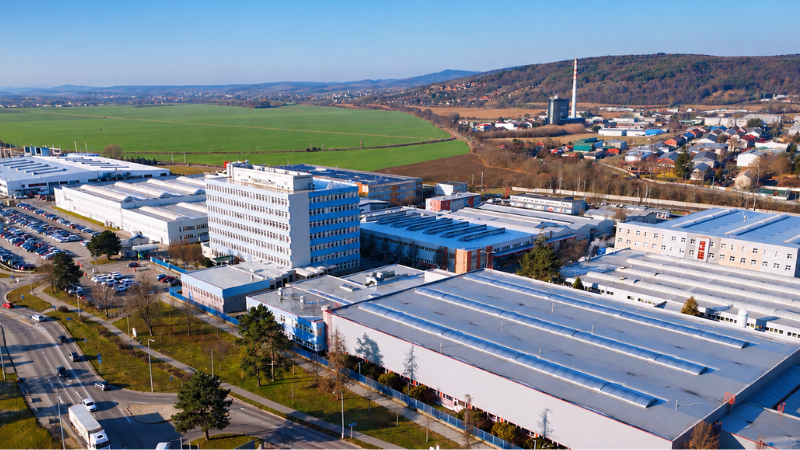
Vertiv (NYSE: VRT), a global provider of critical digital infrastructure, is expanding its campus in Nové Mesto nad Váhom, Slovakia. With this investment, the company is responding to growing demand for digital infrastructure for AI, cloud and data centre environments from customers in Europe, the Middle East and Africa (EMEA).
The expansion marks the next step in Vertiv’s long-term strategy for regional and global growth. Vertiv has previously invested in manufacturing sites in Ireland, Italy, Croatia, Malaysia, Mexico and the United States. These investments are expected to increase Vertiv’s capacity to support customers worldwide as demand for critical digital infrastructure continues to rise.
22,000 square metres of new production space
Over the next 18 to 24 months, Vertiv plans to add around 22,000 square metres of new production space to the campus in Nové Mesto nad Váhom. This will increase manufacturing capacity for power, switchgear and cooling solutions, including liquid cooling and power for high-density AI and high-performance computing environments.
In addition to increasing manufacturing capacity, Vertiv is developing the site further into an integrated technology and manufacturing campus. By bringing engineering, manufacturing and operational expertise together within a single ecosystem, Vertiv expects to be able to respond more quickly to customer needs, shorten lead times and further strengthen the resilience of its EMEA supply chain.
According to Paul Ryan, president of Vertiv in EMEA, the company continues to invest in its manufacturing capacity in EMEA as AI and other business-critical digital applications grow ever faster. Ryan says that with the expansion of Nové Mesto nad Váhom, the company is increasing its ability to support customers in deploying digital infrastructure and strengthening its capabilities for the next generation of AI and high-performance computing applications. As organisations adopt AI more rapidly, speed of deployment is becoming increasingly important, according to Ryan. Reducing time-to-token, the time between deploying infrastructure and realising business value from AI workloads, is therefore high on the agenda. With this investment, the company aims to help customers bring critical power and cooling capacity online faster and at greater scale.
Hundreds of new jobs
The project is expected to create hundreds of new jobs between 2027 and 2029 in manufacturing, engineering, operations, supply chain, quality management, technical roles and management. Vertiv is also making a long-term investment in the talent, skills and expertise needed for the digital infrastructure of the future.
To support this growth, Vertiv continually invests in training, professional development and career opportunities for employees. The company is also developing initiatives to attract talent, encourage internal mobility and support the economic development of the region.
Chris Hales, vice president of operations EMEA at Vertiv, sees Nové Mesto nad Váhom as a manufacturing campus where people, technology and innovation come together to serve technically advanced customers and applications in the market. According to Hales, with this investment the company is strengthening its industrial capabilities and creating an environment in which talent can develop and innovation is encouraged.
Strategic role in EMEA
With the expansion of Nové Mesto nad Váhom, Vertiv is reinforcing its role as a strategic partner for hyperscalers, cloud providers, colocation operators, neocloud providers, enterprise data centres and other business-critical environments. The investment also supports Vertiv’s long-term strategy to further build out its manufacturing capacity in EMEA and to support customers in deploying the power and cooling solutions needed for the next generation of digital services, AI factories and high-density applications.
More information about Vertiv’s portfolio of power, cooling, infrastructure solutions, IT systems and services for critical digital applications is available at www.vertiv.com.
This article was originally published in Dutch on MSP Business. Read the original →