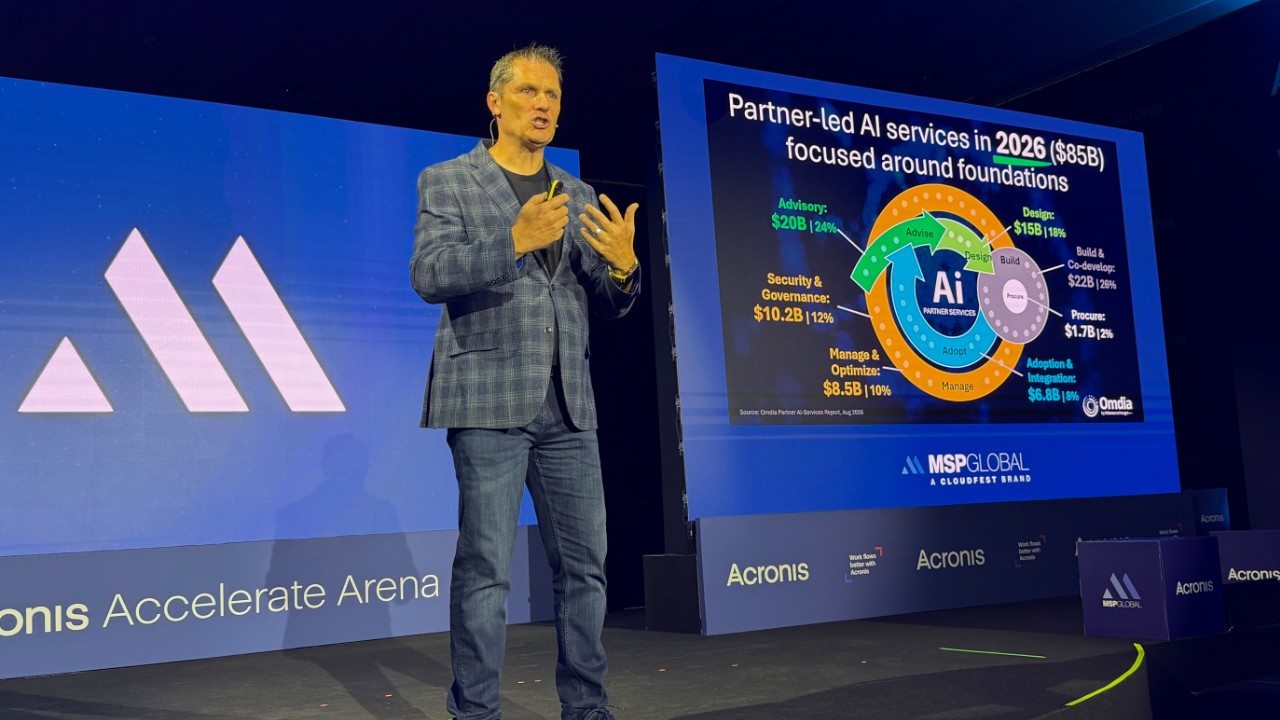
Speaking at MSP GLOBAL in PortAventura near Barcelona, Jay McBain, chief analyst at Omdia, set out how the economics of the partner channel are changing now that AI is set to double the IT market within a few years. His message to a room full of MSPs: customers stopped buying from a single party long ago, the decision is made months before the signature, and vendors are shifting their money to that early phase and to the management that follows. That is the territory where MSPs have earned their living for years, provided they get a seat at the table early enough.
McBain opened with the moon landing 57 years ago, only to say straight away that this was not a space story. In the years that followed, technology was the fastest-growing industry in the world every year, in eras of roughly twenty years: mainframes, client-server, cloud and, since 2023, AI. Each era produces a new richest person and a new largest company, but it also changes the customers. More than half of the Fortune 500 of twenty years ago no longer exists. ‘This is not just a growth story,’ McBain said. ‘It’s a survival and growth story.’ He was equally down-to-earth about the current AI wave, with a new multi-billion alliance in the news every morning: it is also a bubble, just as the dotcom bubble was the prelude to cloud.
Two thirds of all IT money flows through the channel
Global IT spending stands at $6.2 trillion, split roughly evenly between hardware, software, IT services and telecoms. AI infrastructure will be added on top of that in the coming years, which according to McBain will double the market in three to four years. The figure that matters for MSPs: 65 per cent of all that money flows through partners. That is the share of revenue where a reseller, MSP, distributor or marketplace handles the transaction rather than the vendor itself. If you also count the deals in which a partner advises, designs, implements or manages without sending the invoice, the figure rises to 96 per cent. ‘There is no way for any of the 35,000 vendors we track to win without us,’ McBain said.
6.3 partners per deal
The number that recurred throughout the keynote was 6.3. Omdia dissects IT deals down to the invoice, counting how many different partners play a role in a single transaction. On average, there are 6.3. Think of a consultancy that devises the strategy, a systems integrator that builds it, a distributor that supplies it, a marketplace through which the licences run, a software partner with a complementary tool and an MSP that handles management. The customer sees these parties collectively as its IT supplier, even though only one of them sends the bill.
The average conceals large differences. A florist has one partner, the trusted adviser who does everything from pulling cables to repairing cameras. From fifty to a hundred and fifty employees upwards, more and more parties enter the room, and in an enterprise or public sector deal there can easily be more than ten. For the MSP, this means the competition is rarely another MSP. The aim is to occupy one of those 6.3 places around the customer, alongside parties that do something different from you. ‘We need to get better at playing a team sport,’ McBain said.
Those places are in demand. According to McBain, nine out of ten marketing agencies and accountancy firms are now also chasing IT services. His argument for why the specialised MSP will still keep its place is complexity. Customers want someone who understands their function, because in many mid-sized companies the head of marketing spends more on IT than the head of IT. They want someone who knows their sector, their country and European regulations, and their company size. And a good consultant is rarely also a good managed services provider. Every specialisation is a reason for an extra seat at the table.
The buyer is a millennial and wants integrations
According to McBain, the biggest change of the past year is the buyer itself. More than half of IT money is now spent by people born after 1982, who grew up with Netflix and Spotify and are used to subscribing to everything. Three quarters of them would rather not speak to a human during the buying process. Baby boomers and Gen X put service levels, support, price and brand reputation in their RFPs. For the new buyer, integration comes straight in at number one: does it work in my environment, with what I already have? ‘I’ll buy a product that is 80 per cent as good as the alternative if it works better in my environment,’ McBain summarised. For MSPs advising on a stack, that has become the benchmark, and it explains why every vendor now calls itself a platform. In practice, the word mainly means partnership: delivering integrations and building tighter alliances than the competition.
The money is moving from the till to the months before
For decades, everything was paid out at the point of sale: margin for the reseller, marketing budget, bonuses for new customers. When Microsoft, AWS and Google reduced the fee on their marketplaces to three per cent, they were effectively telling the market that handling the money is worth as much as a card payment. Vendors are now spreading the margin that used to fall at that moment across the run-up to the deal and the period after it. Microsoft placed two thirds of its partner money after the point of sale to encourage renewals. A thousand vendors now have a points system of this kind.
Omdia calls that run-up the 28 moments: the steps a buyer goes through before signing, from the first exploratory search to comparing quotes, just as with a car you first choose the type, then the brand, and only then go to the dealer. After that comes the subscription era, in which the customer can decide every thirty days whether to stay or leave. ‘Winning a customer today means winning the first thirty days, and then every thirty days again, forever. Guess what MSPs do for a living?’ The economics are thus catching up with where the channel has always been.
AstraZeneca bought in December, but the deal was decided in August
McBain illustrated what this looks like in practice with a multi-million deal at AstraZeneca, which Omdia has dissected right down to the moment of decision. In December, when the customer signed, all the partners were at the table, including NTT, SoftwareOne and YASH in advisory roles. AWS had hosted the customer twice and lost. Microsoft won because it played the early partner moments better. The lesson for the audience lay in the timing: the winning partners won the deal in August and September, before the chart had even begun. ‘When a very smart person is standing at the whiteboard with a pen, drawing clouds and connecting them, that’s where you win or lose,’ McBain said. With a buyer who would rather not speak to a human, the partner that is already visible in that phase determines who later gets to send the bill.
What is holding AI projects back?
This time last year, the number one story in the trade press was that 95 per cent of AI projects fail. McBain had his doubts about that MIT study, until Accenture reported a day later that nine out of ten projects were also failing at its end. Omdia asked customers about the causes. Hallucinations, data access, security and European compliance were all on the list, but at the top was a shortage of people who can put it together. Just as in the 1990s, when certified Novell and Microsoft engineers filled the gap in networking knowledge and built businesses on it, solving this talent shortage is, according to McBain, the ticket to the next wave of growth. According to Omdia, more than eighty per cent of partners are not yet ready for it. Vendors are responding with hundreds of millions in partner programmes. According to McBain, after a session on the AstraZeneca deal, Michael Dell shifted billions from the point of sale to consultancy and design, ‘because AI factories are sold at the whiteboard, not at the till’.
There is a catch. The same vendors are hedging with their own forward deployed engineers, in case the channel is not ready quickly enough. They then occupy one of those 6.3 places around the customer themselves. McBain expects this to be temporary, because none of these companies wants to be a service provider, and that the work will return to the channel within three to five years. The market is growing fast enough: managed services at ten per cent a year, cybersecurity at twelve per cent and AI services at more than thirty per cent, a multiple of the growth of the customers themselves. Much of the AI work of 2026 is still in the early phase. Towards 2031, that will shift to production, management, compliance and governance, all of it post-sale work.
Therein lies the warning. A few days before the conference, Accenture reported that it now generates more revenue from managed services than from consultancy. The world’s largest companies are becoming MSPs themselves rather than handing the keys to an MSP. ‘If you’re not in early to steer the customer, there may be no RFP later to manage it.’ Humanoid robots and quantum computing are for later, according to McBain. The next three to five years are about helping every customer avoid becoming part of that other half of the Fortune 500.
This article was originally published in Dutch on MSP Business. Read the original →