
MSPs sell AI to their customers and are meanwhile using it extensively in their own businesses. More than half use it to automate tickets, patches and monitoring, and smaller groups deploy it for documentation, security, customer contact and sales. This delivers faster responses, fewer errors and a lighter workload, but little extra margin so far. Most MSPs have automated a quarter of their work at most in two years, the administrative side of the business receives little attention, and vendors themselves do not yet know what their AI agents will cost. The MSPs that demonstrably benefit choose processes with a measurable outcome, keep their data in order and do not give away the time savings in their pricing.
In this article
How much work has really been automated?
Faster responses deliver little margin so far
Administration holds work that lends itself well to automation
More than half of MSPs use AI to automate tickets, patches and monitoring. That is according to Kaseya’s State of the MSP Report 2026, a survey of more than a thousand MSPs worldwide. The same survey shows what automation delivers. Of the respondents, 35 per cent see a faster first response to tickets and 18 per cent a better profit margin.

Those two figures sum up where internal AI at MSPs stands today. The technology works and makes the work lighter, but the translation into business results is lagging behind. Where that translation does succeed, according to benchmarking firm Service Leadership, it has more to do with management than with the tool chosen.
Where are MSPs using AI now?
At the top is the automation of IT tasks at 53 per cent, followed by IT documentation and security at 37 per cent each. Customer support and chatbots come in at 29 per cent, sales and marketing at 26 per cent. Of the MSPs surveyed, 15 per cent do not use AI at all yet.
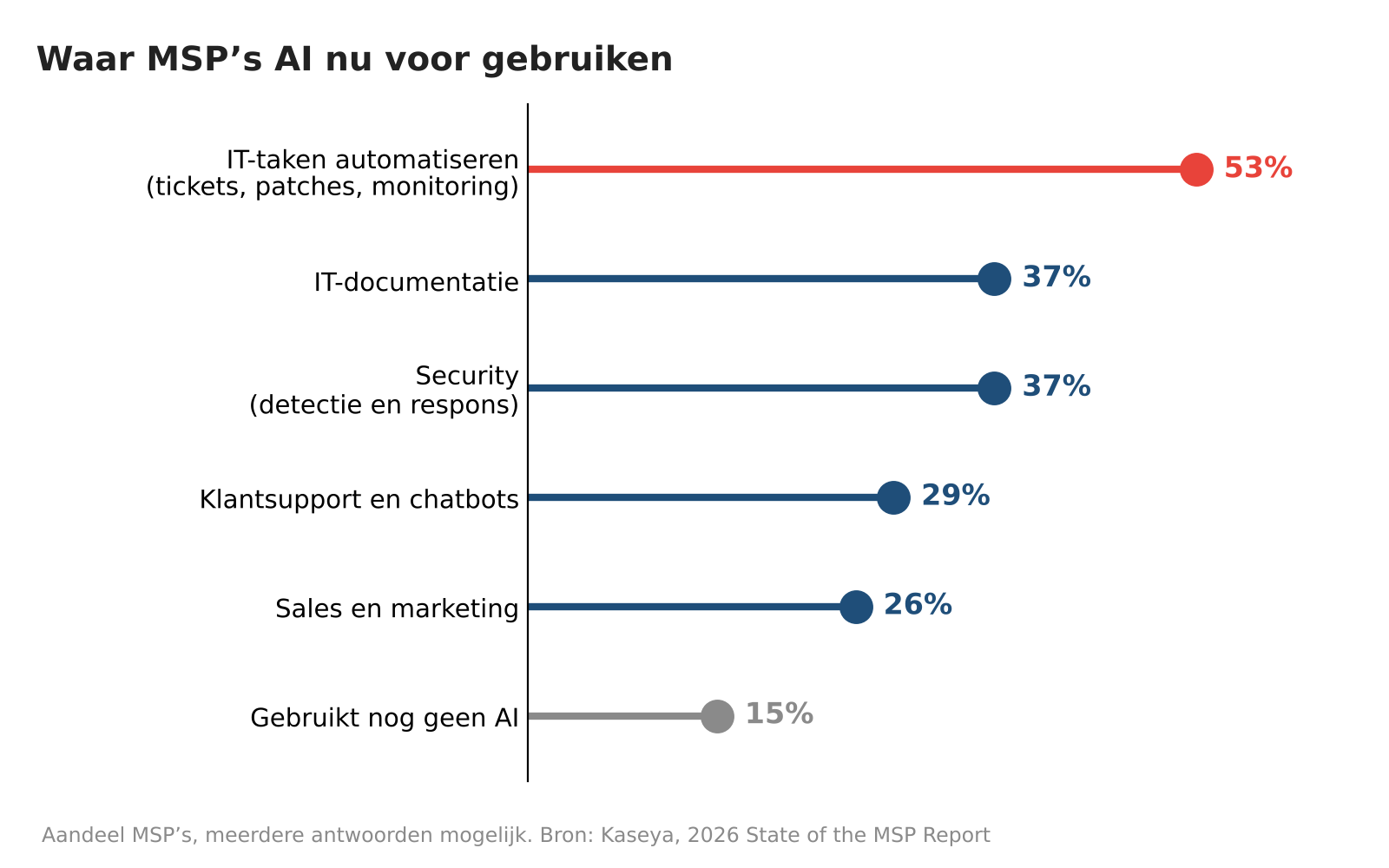
Figure 1. More than half of MSPs use AI to automate IT tasks such as tickets, patches and monitoring. Source: Kaseya, 2026 State of the MSP Report.
A 2025 reader survey by the US trade publication MSP Success paints a different picture of the same shop floor. There, 93 per cent say they use generative AI tools such as ChatGPT, Claude or Copilot internally, and 82 per cent name sales and marketing as the department that benefits most. But while employees opening a chatbot themselves to draft a quote or a blog are found almost everywhere, AI built into a business process is far rarer.
How much work has really been automated?
Kaseya also asked what share of work had been newly automated over the past two years. For 55 per cent of MSPs it is a quarter at most, 28 per cent are at around half and 9 per cent have automated nothing new. ScalePad arrives at a similar picture in its MSP Trends Report 2026. There, 62 per cent say AI plays a role in a quarter or less of their service delivery, and 39 per cent have a written AI strategy that is actually being implemented.
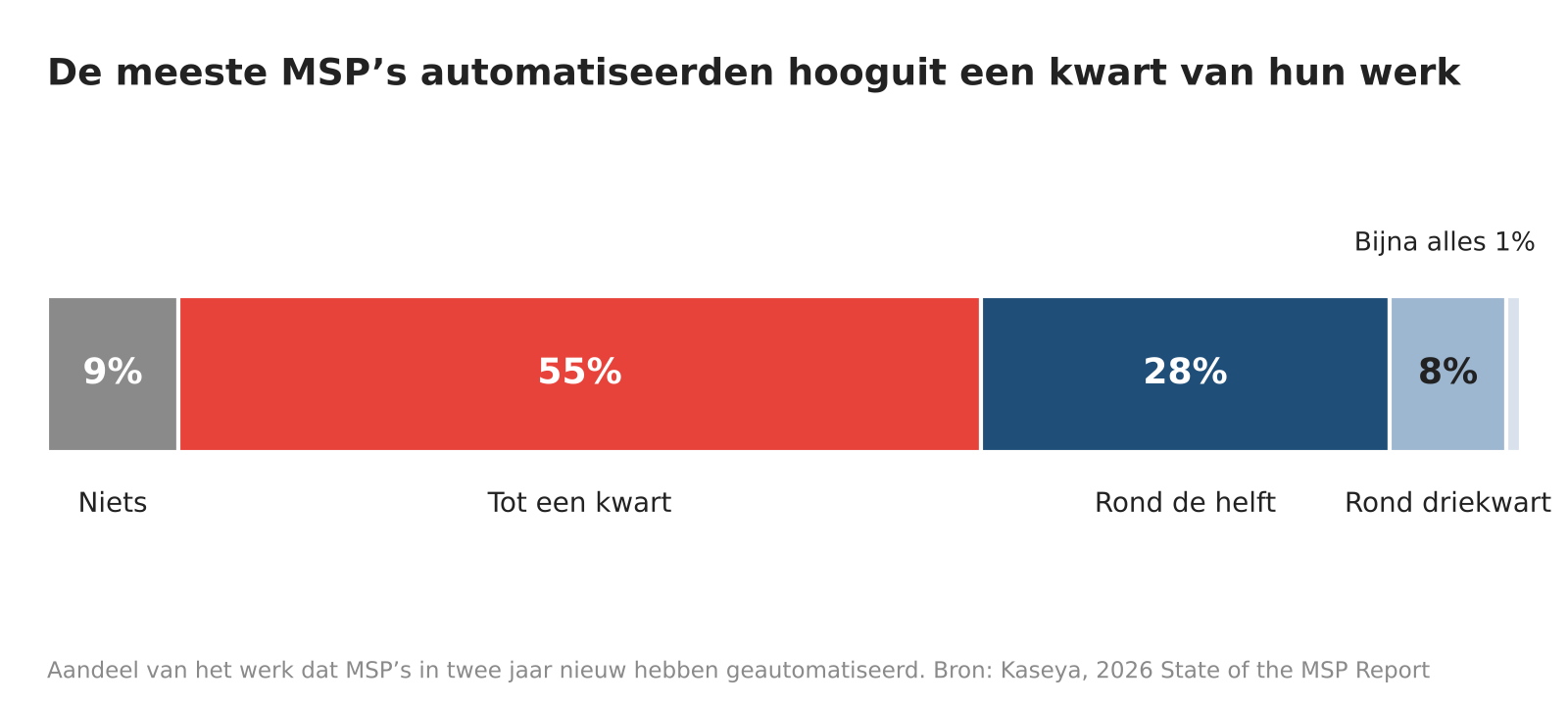
Figure 2. More than half of MSPs automated a quarter of their work at most in two years. Source: Kaseya, 2026 State of the MSP Report.
The newest agents are also still little used. In April, Kaseya unveiled its Kaseya Intelligence platform, headlined by AI agents that route service desk tickets. According to product director Jim Lippie, 5 to 10 per cent of customers use that feature. In June, the Digital Specialists followed in Prague: agents that detect a problem, propose a solution and, once an administrator approves, update a ticket or carry out a remediation action themselves. They will become available to a limited group at the end of this year and to everyone in 2027.
Faster responses deliver little margin so far
According to MSPs themselves, the benefits of automation lie mainly in speed and quality. After the faster first response come higher customer satisfaction at 33 per cent, more efficient technicians at 32 per cent, a lighter workload at 31 per cent and fewer errors at 30 per cent. The financial outcomes are at the bottom, with 18 per cent for a better profit margin and 15 per cent for more accurate billing.
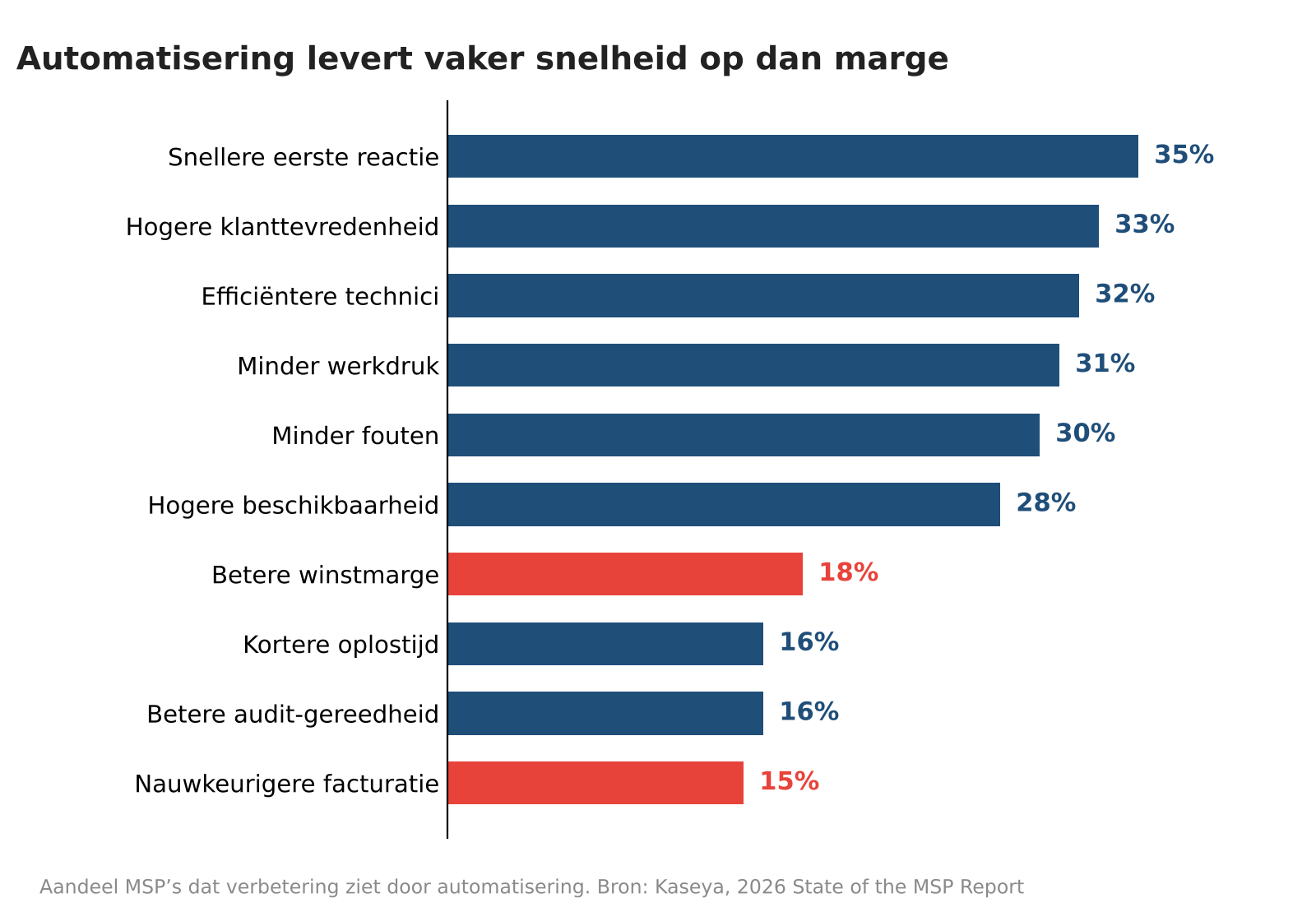
Figure 3. Through automation, MSPs more often see faster responses and higher customer satisfaction than a better profit margin. Source: Kaseya, 2026 State of the MSP Report.
Service Leadership, ConnectWise’s benchmarking firm, has this year compiled an Automation Index for the first time, measuring the effect of AI on MSPs’ figures. The finding is that automation pays off unevenly. The best-performing MSPs become more efficient and hold their prices, while the bottom quartile shows little to no improvement. Time savings passed on to the customer as a discount are lost to the margin.
Administration holds work that lends itself well to automation
Billing is at the bottom of the list of improvements, even though it involves work that lends itself well to automation. Reconciling vendor invoices with what the customer pays is rule-based, the outcome can be verified and every missed licence costs money directly. Charles Henson of US MSP Nashville Computer used the tools Pia and Hatz AI to build an internal app that reads in vendor invoices and compares them with the output of the PSA. The monthly reconciliation used to take hours. ‘Our billing is more accurate than it has ever been,’ Henson tells MSP Success.
The same applies to documentation, customer onboarding and quotes. These are processes with a fixed format and a clear end product, where an error now becomes visible before the customer is affected by it.

What is holding MSPs back?
In ScalePad’s research, MSPs name the cost and complexity of AI tools as their biggest concern, at 44 per cent. Inaccurate outputs and compliance and security concerns follow at 41 per cent each, and employee resistance at 36 per cent. In the MSP Success survey, integration with existing systems is the biggest stumbling block for 57 per cent.
Costs are also uncertain. Kaseya has not yet decided which parts of Kaseya Intelligence will be chargeable and is waiting for usage data from its first customers before doing so. Omdia analyst Jessica Davis warned Channel Dive that consumption-based pricing fits poorly with the fixed monthly fee MSPs charge their customers, meaning they could be left with costs they cannot pass on.
Where do you start?
First, choose one or two processes whose outcome you can measure in hours or euros, such as ticket triage, invoice reconciliation or keeping documentation up to date. Record in advance how much time it currently takes, so that after three months you know what the automation has delivered.
Next, make sure the data the AI works with is correct. An agent that routes tickets based on a messy PSA or outdated documentation makes the same mistakes as a new colleague without an induction period, only faster. For now, have agents that make changes themselves work with approval from an engineer.
Finally, decide what to do with the time freed up. If it goes towards more customers per engineer or billable project work, you will see it reflected in the margin. If the customer negotiates a lower price because the work is now done faster, the investment has mainly benefited the customer.
Sources Kaseya, 2026 State of the MSP Report; Kaseya, press release accompanying the State of the MSP Report 2026; Business of Tech, AI adoption widens operational divide: Peter Kujawa on Service Leadership Index data; MSP Success, AI Is the Next Big Shift: Is Your MSP Ready or at Risk? (October 2025); ScalePad, 2026 MSP Trends Report, technology usage; Channel Dive, Kaseya Intelligence tempts MSPs with wait-and-see agentic platform pricing (May 2026); Dutch IT Channel, Kaseya zet in op agentic AI voor MSP’s en IT-teams (June 2026).
This article was originally published in Dutch on MSP Business. Read the original →