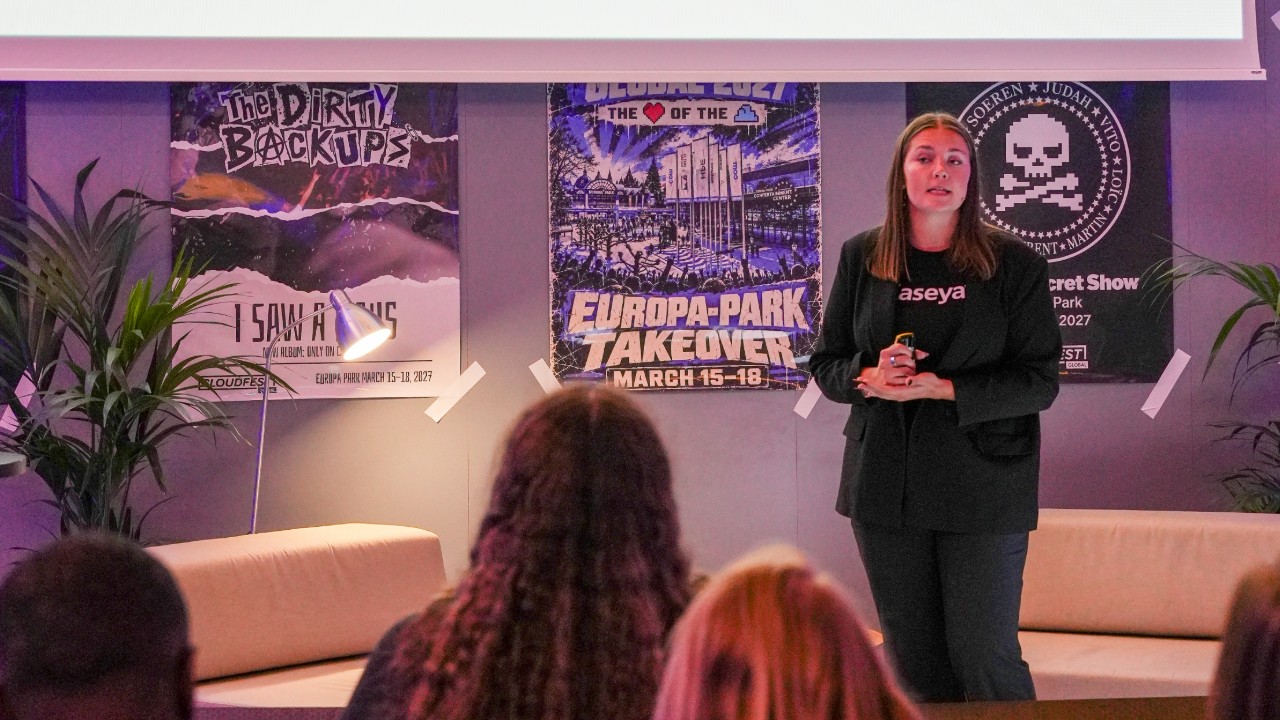
Drop bronze, silver and gold from your website, charge one all-in seat price and aim for a 70 per cent gross margin. That, in a nutshell, was the advice Jenna Vreugdenhil of Kaseya gave MSPs in her masterclass session at MSP Global in PortAventura. Her worked example came to the equivalent of just over €200 per seat per month, which a sizeable part of the audience considered a lot.
Vreugdenhil bases her approach on the pricing framework of Gary Pica, founder of TruMethods, which has been part of Kaseya for a few years. She opened with a scenario most MSPs will recognise. The dream client you are desperate to land, more seats than you are used to, a discount to get them over the line. A year later, that same client turns out to dominate the ticket queue and costs more than it brings in. ‘Mistakes in packaging and pricing are so much harder to fix after you’ve signed the client,’ she said. Having to go back to a client to tell them you are charging too little is a conversation you would rather avoid.
Why not bronze, silver and gold?
According to Vreugdenhil, three packages undermine your own message. She calls it safe, safer and safest. If you know that only the most expensive option truly protects the client, how can you sell the basic package with a straight face? If that client gets hacked, they will look to you regardless. Her advice is therefore a single offering, rolled out across your entire client base, one that will not keep you awake at the weekend.
The same discipline applies to tooling. A client who insists on a different EDR from the one you run as standard often gets it anyway at many MSPs. ‘You’ll never become an expert in several tools at once. Make a choice and get good at it.’ Three brands for the same function mainly confuse your own people.
The list of ingredients on the website should also go, in her view. RMM, BCDR, EDR, SaaS backup: it means nothing to an SME owner and invites comparison with the MSP down the road, who will then ask why your tool isn’t in Gartner. That is a conversation you don’t want to have at all. Sell what you achieve for the client, such as a Christmas holiday without worrying about a hack, or processes that are finally automated.
The vCIO as differentiator
According to Vreugdenhil, the support desk and centralised services have become commodities. Every MSP offers a combination of the two and the client sees little value in them. The differentiation lies in two roles above that. The technology alignment manager is purely proactive: someone who visits clients, reviews their processes and industry software and checks, for example, whether everyone can use Copilot properly. The virtual CIO translates those insights into a roadmap and holds the conversation at board level. This is where we are, this is where we want to go, this is how we get there.
Many MSPs already do this halfway, with QBRs or an annual strategy meeting, without labelling it anywhere. ‘If you already do it and don’t put it on your website and your socials, you’re selling yourself short.’ She compares it to a Michelin-starred restaurant, where everyone excels in one role, from the host to the chef. An engineer who handles support, does a bit of strategy now and then and has to master three tools in the meantime excels at nothing.
Her question to the audience: when did you last speak to your ten largest clients about their business goals for 2027? AI is guaranteed to be among them, and you are in the position to do something about it.
The calculation
Then the figures, based on an example MSP with 1,500 seats across multiple clients. Vreugdenhil calculated in pounds sterling; the figures below have been converted to euros and rounded. Tooling costs this MSP just over €40,000 per month, almost €28 per seat. Three support staff at almost €4,800 per month, each covering 500 seats, add just over €9 per seat. One centralised services employee at almost €6,000 comes to €4. Three technology alignment managers at just over €7,000, also each covering 500 seats, add up to just over €14. And a vCIO at just over €9,500 serving all clients adds another €6 or so. Rounded, the total stands at around €65 per seat per month, excluding your own salary, rent and other business costs.
At a seat price of €70, the margin has all but disappeared. According to Kaseya, the top 10 per cent of MSPs aim for a 70 per cent gross margin on managed agreements, which works out at around €210 per seat per month. When Vreugdenhil asked who thought that was an absurd amount, quite a few hands went up. ‘That’s fair, I get that.’ Even if you think 70 per cent is aiming too high, she says, at least know what really goes into your seat price. The all-in price should include support, centralised services, technology alignment and vCIO. Project work remains separately billable.
Being the most expensive is not a problem
Many MSPs want to sit in the middle of the market, somewhere between cheap and expensive. That way you don’t stand out at all, Vreugdenhil argues. If you turn out to be the most expensive after a good conversation, the prospect will call you to say you are well above the rest. ‘Then you say: that’s right, we hear that a lot, and here’s why. We offer the strategic layer that others don’t.’ In her experience, that conversation leads to a signature far more often than a too-low price leads to anything but a flat no.
She advises against putting your seat price on your website. You would filter yourself out before you have had the chance to explain where the figure comes from. Asked by the audience how a single package fits with upselling, she replied that most additional work actually comes out of the vCIO conversations: projects, compliance requirements that call for an extension of the package and, increasingly, AI as a service. At small MSPs, the owner fills the vCIO role themselves at first.
Incidentally, Kaseya does not yet have a commercial framework for AI as a service. Vreugdenhil hears many MSPs asking how to package and price it, and says work on this is under way within the peer programme.
TruPeer, Kaseya’s peer programme
The pricing framework from the session comes from TruPeer, the peer programme Kaseya acquired with TruMethods. In Europe it has more than 200 members, grouped in pods with MSPs of similar size and growth ambitions. Members get access to Smart Numbers, a benchmarking platform with more than 100 metrics on profitability and operations, such as reactive time per ticket and clients who cost more than they bring in. The pod acts as an informal board of directors that holds you to your plans. Membership does not require Kaseya products and there are no Kaseya salespeople in the room.
Vreugdenhil gave an example of how that works. In one pod, MSPs compared each other’s proposals. One of them put a 25-page proposal on the table, to which a Dutch member responded: ‘What is this? I don’t want to read this, so why would your client want to read it?’ That directness, she says, is the strength of the programme.
This article was originally published in Dutch on MSP Business. Read the original →