Circular IT and device-as-a-service have been sold on sustainability for years, and for all those years SME clients simply carried on ordering new. Refurbished was cheaper, but new was affordable enough to leave that difference on the table. Now everything has changed. IDC expects the average PC price to rise by 17 per cent because of the memory shortage, manufacturers are warning of increases of 15 to 20 per cent, and 64 per cent of channel partners see refurbished sales rising as a result. The sustainability claim also holds up: 70 to 75 per cent of a laptop’s CO2 footprint lies in production, transport and end-of-life processing. Extending therefore beats replacing. And regulation is helping: the scaled-back CSRD only affects SME clients through the questionnaire from their large customers, while ecodesign requirements and the Right-to-Repair Directive make repair and the supply of spare parts an obligation for manufacturers. In the Netherlands, 58 per cent of employees are open to refurbished, 19 per cent work with used equipment, and 59 per cent of organisations have equipment lying unused in a cupboard. A circular DaaS offering from the MSP kills three birds with one stone: a refurbished tier alongside new, a refresh cycle based on the condition of the device (rather than a fixed 36 months), and take-back with redeployment, onward reuse or certified disposal. All of it recorded in a quarterly report that makes it verifiable.
In this article
Why a longer lifespan delivers more than a more energy-efficient device
What is Brussels regulating, and what does the SME client notice?
Where is the gap in Dutch practice?
So what does a circular DaaS offering look like?
IDC expects global PC sales to shrink by 11.3 per cent in 2026, while the average selling price rises by 17 per cent. The cause is the memory shortage: DRAM and NAND are going to AI data centres as a priority, and PC manufacturers are footing the bill. IDC sees no return to 2025 price levels within the horizon of its forecast, which runs to the end of 2027. Dell, Lenovo, HP, Acer and ASUS have already warned their partners of price increases of 15 to 20 per cent on systems delivered in the second half of 2026. A client who bought a business laptop for €900 in 2024 will get a stripped-down version for the same amount in 2026 (or a quote they are not going to sign).
Analyst firm Omdia was already seeing that effect in the channel in March 2026: 64 per cent of channel partners worldwide expect sales of refurbished hardware to rise further in the coming months. Customers’ motivation is shifting in the process, writes senior analyst Ben Caddy. Sustainability remains an important driver, especially in Europe, but buyers on a tight budget simply can no longer afford top prices for brand-new kit. That opens the door for the MSP to start a conversation about refurbished.
Why a longer lifespan delivers more than a more energy-efficient device
The sustainability claim behind circular IT is better substantiated than most marketing claims in the sector. In 2024, researchers from the National University of Singapore and Ghent University compared the environmental reports of Apple, Dell, Fujitsu and Microsoft. For a laptop, 70 to 75 per cent of total lifetime CO2 emissions are accounted for by production, transport and end-of-life processing; electricity consumption during use makes up the rest. For smartphones, that share is 80 to 85 per cent. Only for heavy desktops and always-on devices does the use phase dominate. Dell arrives at similar proportions in its own product studies: for a business Latitude, around three quarters of the footprint lies in the factory.
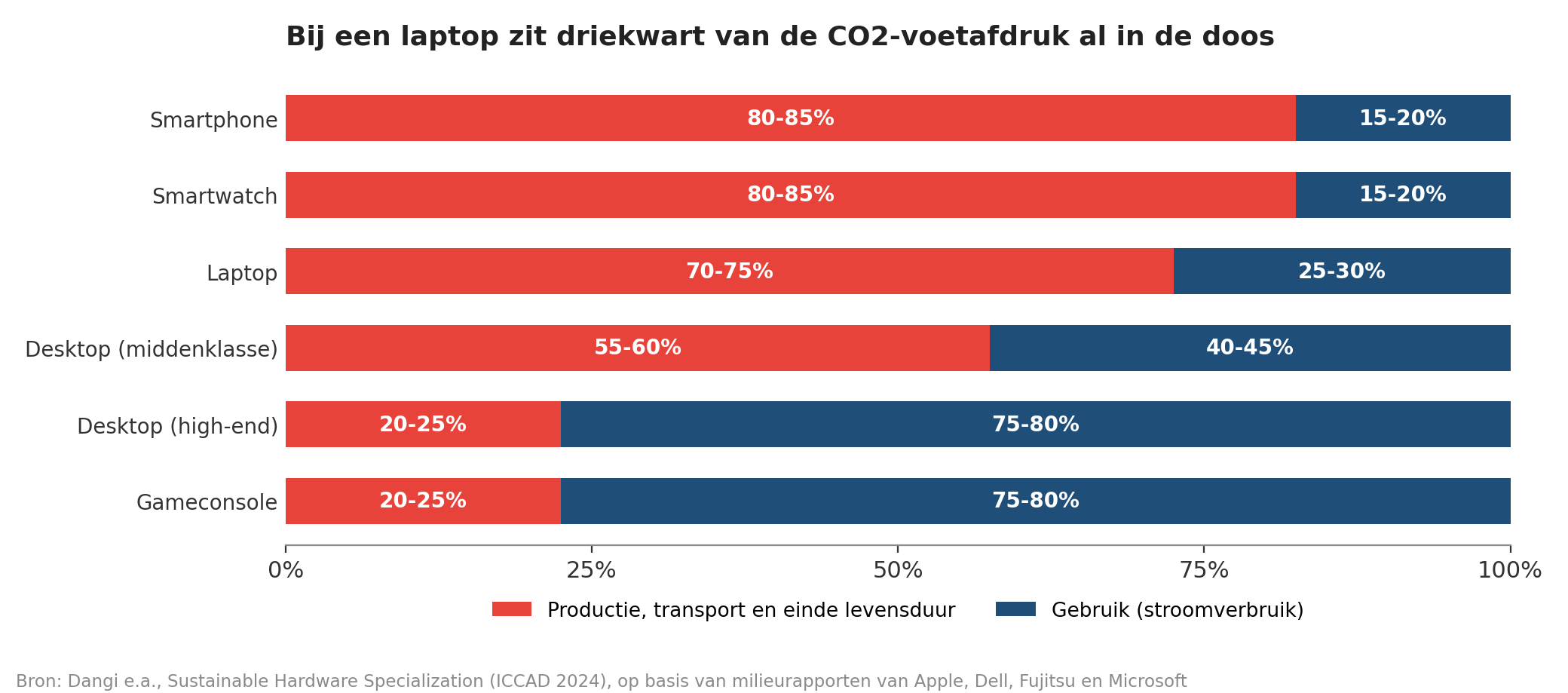
Figure 1: For laptops and smartphones, most of the CO2 footprint lies in production, transport and end-of-life processing. Source: Dangi et al., Sustainable Hardware Specialization (ICCAD 2024).
The implications are clear. A new laptop that is ten per cent more energy-efficient saves ten per cent of a quarter. A laptop that lasts five years instead of three spreads three quarters of its footprint over two extra years. Extending beats replacing, and that also applies to the refurbished laptop that represents the second life of a written-off device from a larger company. For the MSP, that is a different story from the fixed three-yearly refresh baked into many DaaS contracts. A device-as-a-service model that delivers a new box every 36 months is in effect a financing product, even if it carries a sustainability label. It only becomes circular when the contract also stipulates what happens to the device after those 36 months.
What happens now is shown by the Global E-waste Monitor from ITU and UNITAR. In 2022, the world produced 62 million tonnes of electronic waste, 82 per cent more than in 2010. Of that mountain, 22.3 per cent was demonstrably collected and recycled. E-waste is growing five times faster than documented recycling, and if policy remains unchanged the world will reach 82 million tonnes by 2030, with the recycling rate falling to 20 per cent. Europe performs better than the global average, with a collection rate of almost half. But that still means the other half disappears.
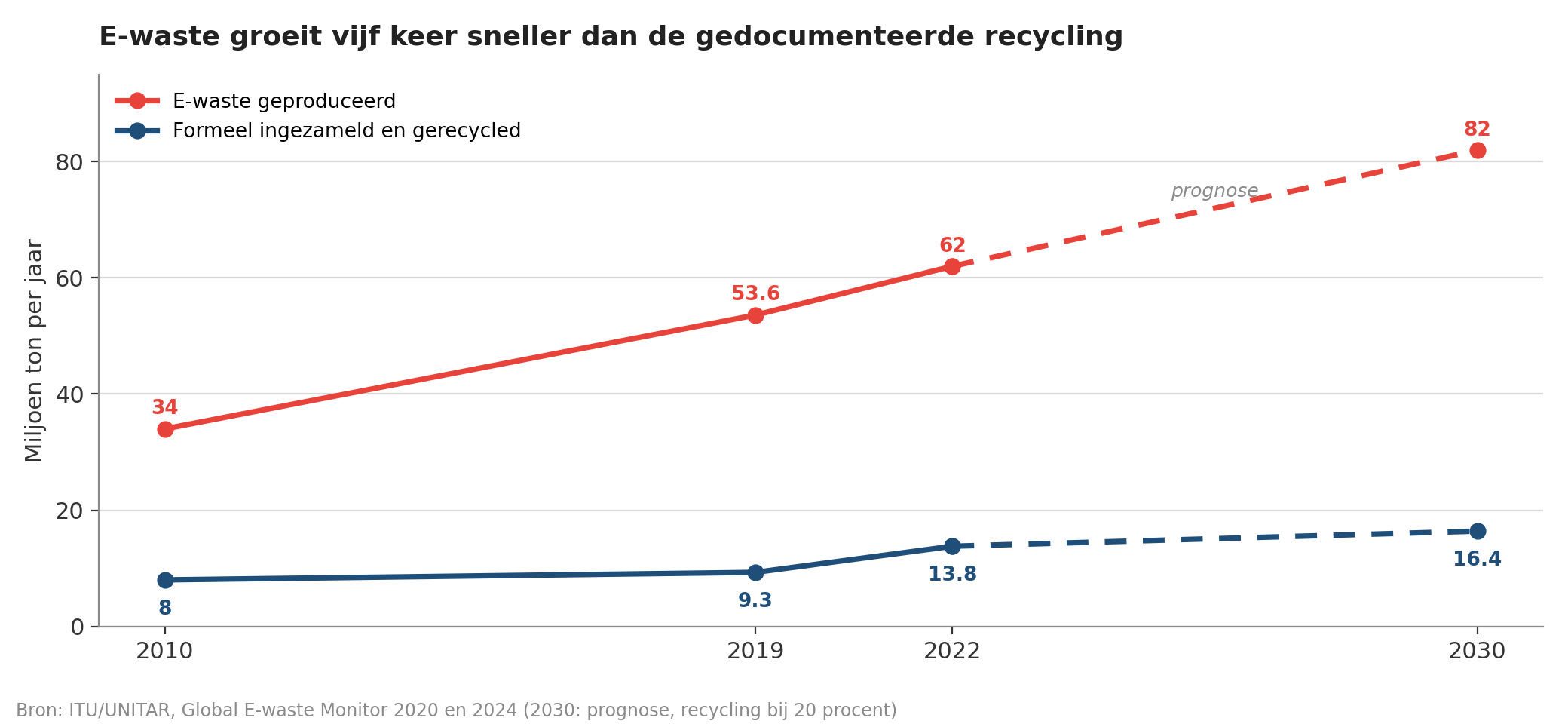
Figure 2: Globally, e-waste is growing much faster than formal collection and recycling. Source: ITU/UNITAR, Global E-waste Monitor 2020 and 2024.
What is Brussels regulating, and what does the SME client notice?
Regulation feeds into the MSP conversation in two ways, and the first is less direct than is often claimed. The CSRD, the sustainability reporting obligation, was sharply curtailed by the Omnibus directive of February 2026: only companies with more than a thousand employees and more than €450 million in turnover will still have to report from financial year 2027. An estimated eighty per cent of the original target group thus falls outside the obligation. An MSP’s SME client therefore does not have to produce a CSRD report. If they supply a large company that does fall under the CSRD, however, they can still expect a questionnaire. Such a company must also report on its suppliers and asks them for figures to do so. This mainly applies to B2B suppliers and much less to SMEs selling to consumers. The Omnibus limits what that customer may ask to the voluntary VSME standard, and that standard does include the CO2 footprint of the company’s own operations. The client’s IT inventory, with year of purchase, lifespan and disposal, is therefore a concrete piece of data the MSP can supply.
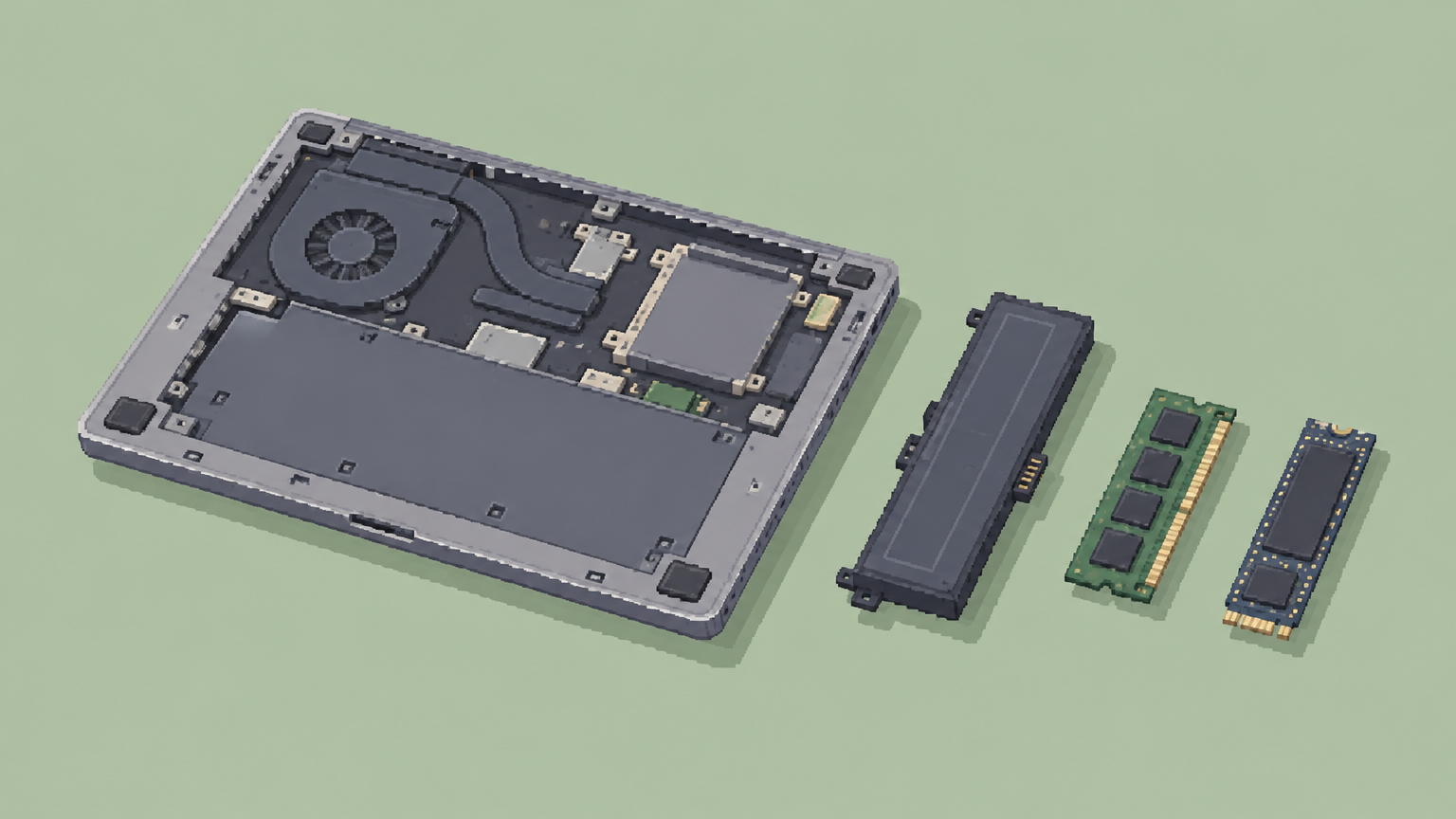
The second effect concerns the devices themselves. Since June 2025, European ecodesign requirements have applied to smartphones and tablets: batteries that can withstand 800 charge cycles, spare parts that remain available for seven years after the last unit is sold, at least five years of operating system updates and a repairability score on the energy label. Since 31 July 2026, the Right-to-Repair Directive has required manufacturers to repair products covered by such requirements at a reasonable price, including outside the warranty period. For laptops, the revision of the ecodesign regulation for computers is still under way; the European Commission held the consultation on the draft texts at the end of 2024, with similar requirements for repair, batteries and updates. The consequence for the MSP is that, in a few years, laptop repair will be a regulated service with fixed timeframes for parts, and that a provider already set up for this has a head start.
Where is the gap in Dutch practice?
In the Netherlands, the brake on circular IT lies more often with the organisation than with the user. The IT-Indicator 2026 from Aces Direct, a survey of more than a thousand Dutch workers at organisations with 250 to 1,200 employees, shows that 58 per cent are open to refurbished equipment, while 19 per cent actually work with it. Almost half received a new device. At the same time, 59 per cent of organisations have IT assets lying unused in a cupboard, mainly laptops, accessories and phones that were never deployed after purchase. Three in ten employees do not know what happens to the equipment of departing colleagues. Senior management describes its own IT policy as very sustainable in 23 per cent of cases; on the shop floor, the figure is four per cent.
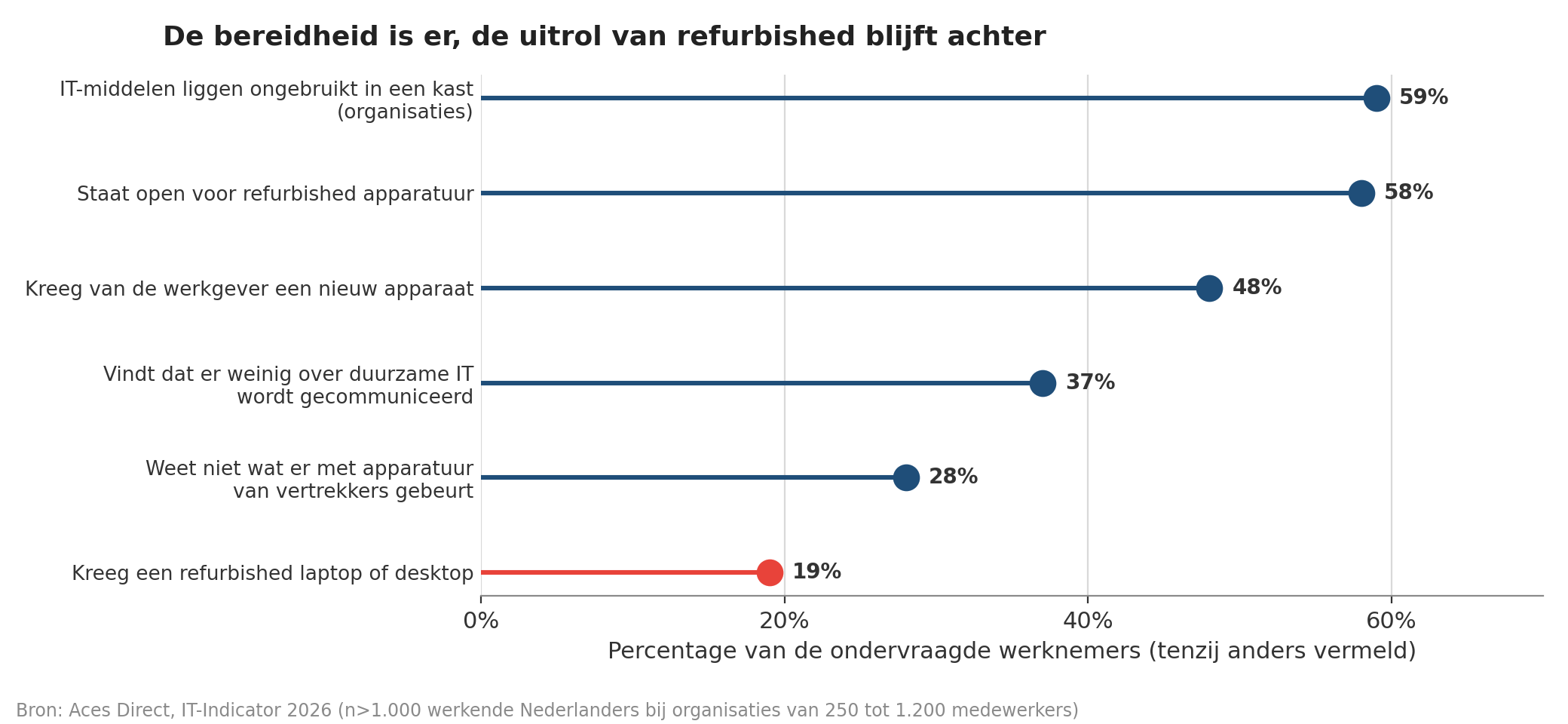
Figure 3: Dutch employees are open to refurbished, but roll-out lags behind and the stock in the cupboard keeps growing. Source: Aces Direct, IT-Indicator 2026.
That is a sizeable gap for the MSP to step into. The survey covers organisations larger than the average MSP client, but the situation is a familiar one: no visibility of what is lying around, no process for what comes back at offboarding, and a buyer who orders a new box as standard for every new employee. Gartner predicts that by 2028, seventy per cent of organisations will outsource device lifecycle management to a service provider, compared with less than 35 per cent in 2025, and in its Market Guide of June 2025 it names circularity (redeployment, repurposing, reuse) as a core capability of such a provider for the first time. For the MSP that already manages the client’s RMM platform, onboarding and service desk, the step to lifecycle management is a small one. After all, the inventory is already in there.
So what does a circular DaaS offering look like?
The essence is that the MSP becomes the owner of the lifecycle, rather than just the supplier of the box. That starts at intake: a refurbished tier alongside a new one, with the same SLA, the same security baseline and a clear price difference. The Omdia figures and IDC’s price increases make that tier easy to sell in 2026. Next comes a refresh cycle determined by the condition of the device and the requirements of the software rather than by a fixed 36 months; with Windows 11 and a modern processor, five years of office work is no problem, and the battery is replaceable in the new generation of devices.
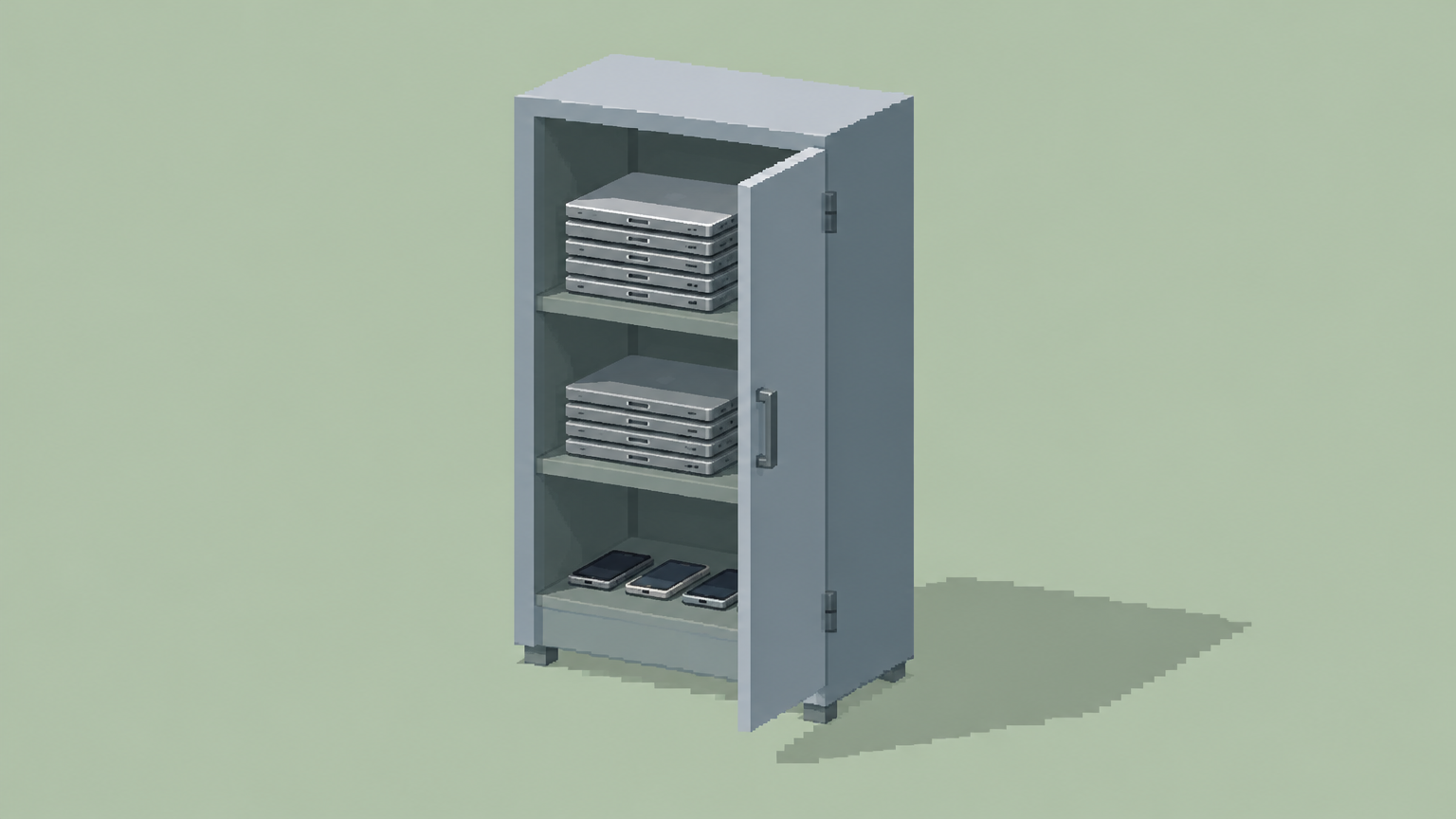
Then comes the part most DaaS contracts skip: take-back. Every device that comes back is given one of three destinations. Redeployment at the same client, with a clean installation for the next employee. Onward use at another client or in the refurbished tier, after a technical inspection. Or disposal via an ITAD partner, with a data destruction certificate per serial number. For the client, that certificate is proof of compliance with their GDPR obligations and, soon, also for their customer’s questionnaire. Moreover, for the MSP it is the point at which a sustainability promise becomes verifiable. A quarterly report showing, for each device, its age, its destination after take-back and the purchase avoided closes the loop. And when a DaaS provider calls itself circular, ask whether that report exists.
Omdia does see a limit to this model. If clients use their equipment for longer, the supply of young, high-quality hardware to the refurbished market dries up. The MSP that bases its refurbished tier on the inflow of written-off enterprise laptops will soon be competing with the manufacturers themselves, who are expanding their own certified refurbished lines and taking back the best devices first. The answer is the shift from resale to maintenance: the margin lies in making what the client already has last longer, with batteries, SSDs and memory as replaceable parts. Omdia calls this lifecycle extension services, and it is the service that ecodesign rules will turn from a niche market into an obligation in the coming years.
Sources: IDC, PC Market Enters Volatile Territory as Memory Shortage Persists Through 2027 (June 2026); IDC, Higher ASPs, Lower Unit Volumes: How the Memory Crisis Is Reshaping the PC and Smartphone Outlook (February 2026); Omdia Supply Chain Survey, via Dutch IT Channel: Refurbished IT: De nieuwe standaard in 2026 (March 2026); Dangi et al., Sustainable Hardware Specialization, ICCAD 2024 (National University of Singapore/Ghent University); Dell, Carbon Footprint of a Dell Latitude E5540 (product study); ITU/UNITAR, Global E-waste Monitor 2024 (March 2024); ITU/UNITAR, Global E-waste Monitor 2020; Council of the EU, press release on the Omnibus agreement on the CSRD and CSDDD (December 2025); Accountancy Europe, Omnibus explained: key changes to the CSRD and CSDDD (April 2026); European Commission, ecodesign and energy labelling rules for smartphones and tablets (June 2025); European Commission, Directive on repair of goods; European Commission, Ecodesign requirements for computers (review); Aces Direct, IT-Indicator 2026, via MSP Business (September 2026); Gartner, Market Guide for Managed Device Life Cycle Services (June 2025), via Firstbase.
This article was originally published in Dutch on MSP Business. Read the original →